
10 Cold Email Templates You Can Use with Lemlist
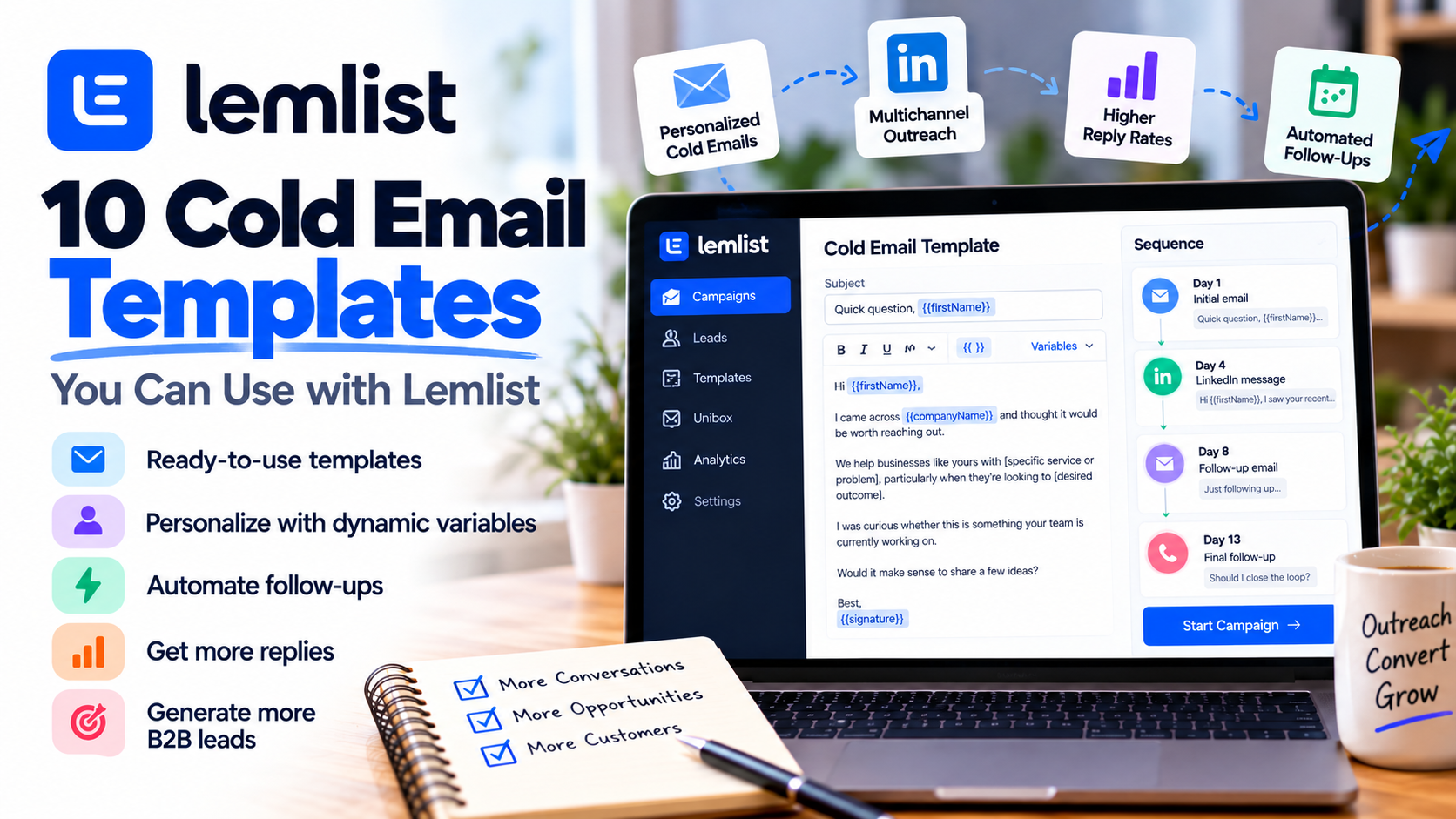
Cold emailing can be one of the most effective ways to connect with potential customers, generate B2B leads, and start conversations with decision-makers.
But there's one problem: most cold emails sound exactly the same.
You've probably received messages that begin with something like:
"Hi, I hope this email finds you well. We are a leading provider of innovative solutions..."
And you've probably ignored them.
The problem isn't necessarily cold emailing itself. It's that many businesses send generic messages without considering what their prospects actually need.
That's where Lemlist can help.
With email personalization, automated sequences, lead enrichment, and multichannel outreach, Lemlist makes it easier to create targeted campaigns without manually writing every email.
In this article, I'll share 10 cold email templates you can customize and use with Lemlist to start more meaningful sales conversations.
Why Use Cold Email Templates with Lemlist?
Writing every cold email from scratch can take hours, especially when you're contacting hundreds of prospects.
Templates provide a starting point.
Instead of reinventing your messaging, you can create reusable structures and personalize them using information about each prospect.
Lemlist supports personalization variables such as {{firstName}}, {{companyName}}, and {{icebreaker}}.
You can also create custom variables based on your prospect data.
The key is to use templates as frameworks, not as identical messages sent to everyone.
Here are 10 examples.
1. The Simple Introduction Email
Best for: Introducing your business to a new prospect.
Subject: Quick question, {{firstName}}
Hi {{firstName}},
I came across {{companyName}} and thought it would be worth reaching out.
We help businesses like yours with [specific service or problem], particularly when they're looking to [desired outcome].
I was curious whether this is something your team is currently working on.
Would it make sense to share a few ideas?
Best,
[Your Name]
Why it works: This template is short, conversational, and doesn't immediately pressure someone into booking a meeting.
With Lemlist, you can personalize the introduction using your prospect's name, company, and relevant business information.
2. The Problem-Solution Email
Best for: Businesses selling a solution to a specific challenge.
Subject: An idea for {{companyName}}
Hi {{firstName}},
I've noticed that many companies in [industry] struggle with [specific problem].
That often leads to [negative business consequence].
We help businesses address this by [brief explanation of your solution].
Would improving this area be relevant to {{companyName}} right now?
Happy to share more details if useful.
Best,
[Your Name]
Why it works: Rather than immediately promoting your product, you're focusing on a problem the prospect may recognize.
The more accurately you understand that problem, the more relevant your email becomes.
3. The Personalized Observation Email
Best for: Reaching decision-makers with highly relevant messaging.
Subject: Noticed something about {{companyName}}
Hi {{firstName}},
{{icebreaker}}
I thought I'd reach out because we help companies with [relevant service], and your recent activity caught my attention.
We've been working on ways to help businesses [specific benefit].
Would you be open to hearing one idea that might be relevant to your team?
Best,
[Your Name]
Why it works: The personalized opening makes the message feel less generic.
Lemlist supports custom variables and AI-assisted personalization, which can help you create different opening lines based on prospect research.
Just make sure the observation is accurate and genuinely relevant.
4. The Value-First Email
Best for: Consultants, agencies, and service providers.
Subject: A quick idea for {{companyName}}
Hi {{firstName}},
I was looking at {{companyName}} and noticed [specific opportunity].
One approach worth considering might be [brief actionable suggestion].
We've helped businesses work through similar challenges using [relevant method].
Would you like me to send over a short breakdown of how this could work?
Best,
[Your Name]
Why it works: You're offering something useful before asking for a commitment.
This can be particularly effective when you're contacting busy executives who receive numerous sales emails.
5. The Social Proof Email
Best for: Businesses with relevant customer success stories.
Subject: How we helped [similar company]
Hi {{firstName}},
We recently worked with [similar company] to address [specific challenge].
By implementing [solution], they achieved [verified result].
I thought this might be relevant because {{companyName}} operates in a similar space.
Would it be helpful if I shared how we approached the project?
Best,
[Your Name]
Why it works: Real customer results can make your offer more credible.
However, only include case studies and results you can substantiate.
With Lemlist, you can create separate campaigns for different industries and use the most relevant examples for each audience.
6. The Cold Email Follow-Up
Best for: Following up when someone hasn't responded.
Subject: Re: [Original Subject]
Hi {{firstName}},
Just wanted to follow up on my previous email.
I thought [specific benefit] might be relevant to {{companyName}}, particularly if your team is currently focused on [business priority].
Would this be worth exploring, or is it not a priority right now?
Best,
[Your Name]
Why it works: This follow-up is polite, concise, and gives the prospect an easy way to respond.
Lemlist lets you build automated follow-up sequences so you don't have to manually remember every conversation.
For threaded follow-ups, keep the original subject rather than creating a misleading new conversation.
7. The Free Resource Email
Best for: Building trust through educational content.
Subject: Resource for {{companyName}}
Hi {{firstName}},
I recently put together a short guide covering [specific topic].
It explains a few practical ways businesses can [desired outcome].
Since {{companyName}} works in [industry], I thought you might find it useful.
Would you like me to send it over?
Best,
[Your Name]
Why it works: Instead of asking someone to buy immediately, you're offering information that could help them.
This approach works well for businesses selling consulting services, software, training, or other solutions that require trust.
8. The Recent Company News Email
Best for: Reaching prospects after a meaningful business development.
Subject: Congrats on the recent news
Hi {{firstName}},
I saw that {{companyName}} recently [announced funding, launched a product, or expanded its team].
Congratulations!
When businesses reach this stage, [relevant challenge] can sometimes become more important.
We help teams manage that transition through [brief solution].
Is this something you're currently thinking about?
Best,
[Your Name]
Why it works: You're connecting your outreach to something happening in the prospect's business.
This can be more compelling than sending the same pitch regardless of timing.
With Lemlist, you can organize prospects into targeted lists and personalize messaging around verified business signals.
9. The Meeting Request Email
Best for: Prospects who have a clear reason to consider your solution.
Subject: Worth a quick conversation?
Hi {{firstName}},
I'm reaching out because we help [type of company] improve [specific business outcome].
Based on [relevant observation], I thought there might be an opportunity to help {{companyName}} with something similar.
Would you be open to a brief 15-minute conversation next week to see whether there's a fit?
Best,
[Your Name]
Why it works: The request is straightforward.
Instead of overwhelming the recipient with product features, you're explaining why a conversation might be worthwhile.
Use this template when you've already established a clear connection between your offer and the prospect's needs.
10. The Breakup Email
Best for: Ending an outreach sequence respectfully.
Subject: Should I close the loop?
Hi {{firstName}},
I've reached out a couple of times about [specific topic], but I understand it might not be a priority.
I don't want to keep filling your inbox.
If improving [business outcome] becomes relevant in the future, I'd be happy to reconnect.
Otherwise, I'll leave things here.
Wishing you and the team at {{companyName}} continued success.
Best,
[Your Name]
Why it works: This email respects the prospect's time and provides a natural conclusion to the sequence.
Not everyone is interested in your product or service, and that's perfectly fine.
Sometimes ending a conversation professionally is better than continuing to send reminders.
How to Use These Templates in Lemlist
Now that you have 10 templates, how do you actually use them?
Here's the workflow I recommend.
Step 1: Build a Targeted Prospect List
Start by identifying your ideal customer.
You can use Lemlist to research prospects and organize leads based on relevant characteristics.
Focus on job titles, industries, company sizes, and business challenges.
Step 2: Choose the Right Template
Don't use every template for every prospect.
For example, a new prospect might receive the Simple Introduction Email, while a company that recently announced funding could receive the Recent Company News Email.
Match your message to the reason you're reaching out.
Step 3: Add Personalization Variables
Replace generic details with dynamic fields such as:
{{firstName}}{{companyName}}{{icebreaker}}
You can also create custom variables for industry, business challenges, and other information.
Always preview your messages before launching a campaign.
Step 4: Build Your Email Sequence
Lemlist allows you to organize messages into automated sequences.
For example, a simple sequence could look like this:
Day 1: Personalized introduction.
Day 4: Follow-up with a useful insight.
Day 8: Relevant case study or resource.
Day 13: Final follow-up or breakup email.
This is an example, not a universal schedule. Adjust the timing and number of touches based on your audience and results, and stop outreach when someone opts out.
Step 5: Test and Improve
Don't assume your first version will perform perfectly.
Experiment with different subject lines, opening sentences, value propositions, and calls to action.
Lemlist offers campaign analytics and A/B testing capabilities to help you evaluate what works.
Focus on meaningful outcomes such as positive replies and booked meetings rather than simply sending more emails.
Best Practices for Better Cold Email Results
Even the best template won't work if your targeting is poor.
I recommend keeping emails short, writing conversationally, and focusing on one clear benefit.
Avoid exaggerated promises, fake urgency, and unnecessary attachments.
Most importantly, make sure your outreach complies with applicable laws, including consent and unsubscribe requirements. In Canada, CASL can apply to commercial electronic messages, so having someone's business email address doesn't automatically mean you have permission to contact them.
Remember that personalization isn't just adding someone's first name. It's explaining why your message matters to that particular person.
Final Thoughts: Better Cold Emails Start With Better Conversations
Cold email templates can save time, but they shouldn't make your outreach sound robotic.
The goal is to start meaningful conversations with people who might genuinely benefit from what your business offers.
That's why I think Lemlist is worth considering for B2B outreach.
It combines reusable email templates, personalization variables, automated follow-ups, lead data, and multichannel capabilities in one platform.
Whether you're a freelancer looking for clients, a consultant promoting services, or a sales team generating B2B opportunities, these 10 templates provide a useful starting point.
The secret isn't sending the perfect email to everyone. It's sending a relevant email to the right person at the right time.
If you're ready to build more personalized outreach campaigns, explore Lemlist and see how it can fit into your sales process.
If you need help setting up Lemlist, get in touch with me.