
Apollo: A Smarter Way to Simplify Your Daily Workflow
Modern sales teams have no shortage of tools. The challenge is getting those tools—and the people using them—to work together efficiently.
Prospecting may happen in one platform, contact information might live somewhere else, outreach requires another application, and customer information ultimately needs to make its way into a CRM. Before long, sales representatives can spend a significant portion of their day switching between applications instead of actually connecting with potential customers.
That is where Apollo can help.
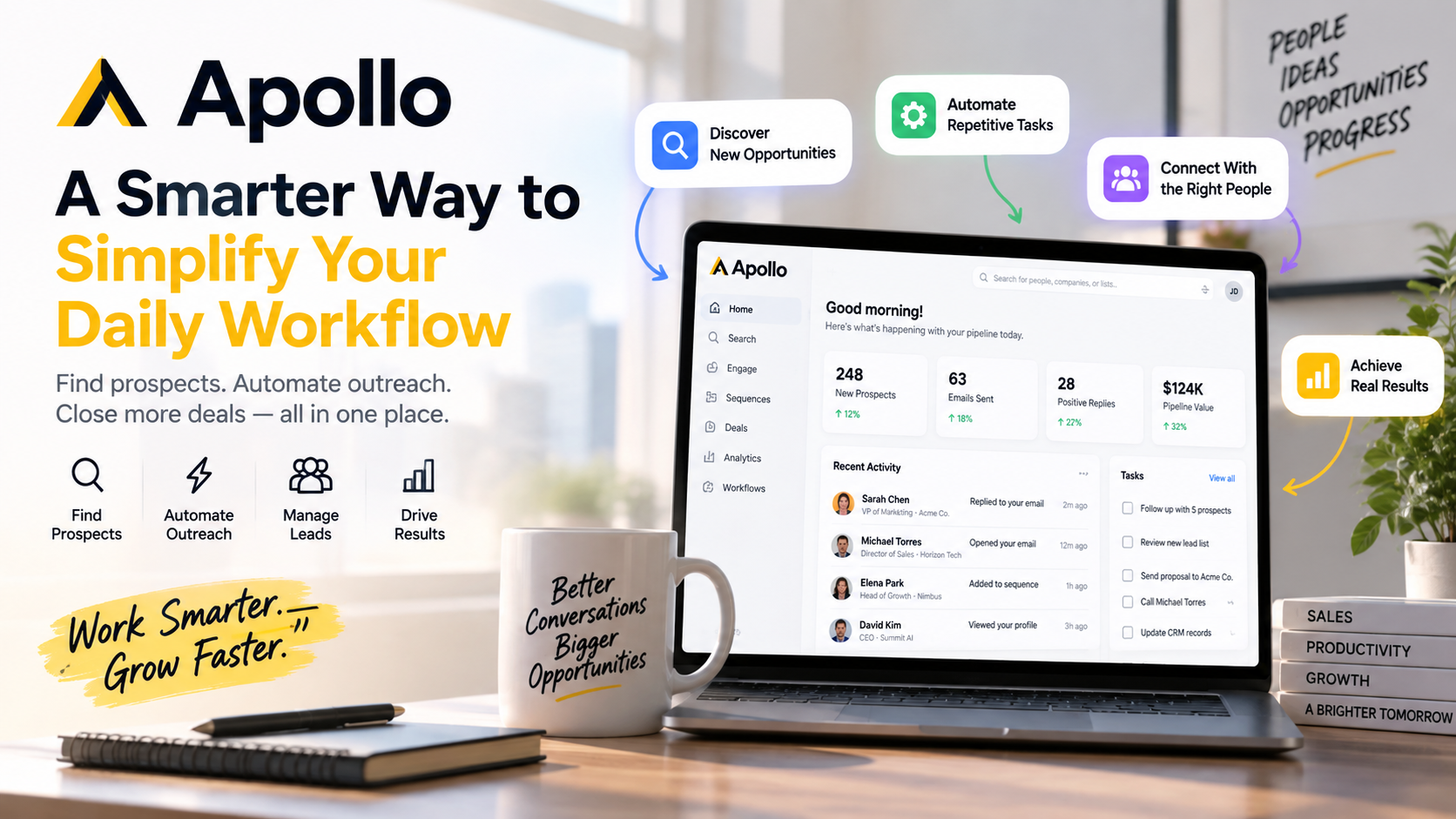
Designed as an all-in-one go-to-market platform, Apollo brings prospecting, sales intelligence, engagement, automation, data enrichment, and other sales activities into a more centralized environment.
For businesses trying to simplify their daily sales workflow, that combination can make Apollo an interesting alternative to managing a collection of disconnected tools.
The Problem With a Fragmented Sales Workflow
Think about a typical morning for someone working in B2B sales.
They may start by searching for companies that match their ideal customer profile. Once they identify a promising business, they need to find the right decision-maker, locate reliable contact information, add the person to their CRM, write an email, schedule a follow-up, and keep track of the interaction.
Doing that for one prospect isn't necessarily difficult.
Doing it for dozens—or hundreds—is a different story.
Small repetitive tasks begin consuming valuable time. Copying information between platforms, updating records, creating reminders, checking spreadsheets, and moving prospects into outreach campaigns can all distract sales professionals from higher-value activities.
With Apollo, many of these activities can exist within the same ecosystem.
Find the Right Prospects More Efficiently
One of the most important parts of any sales workflow is determining who you should contact in the first place.
Instead of spending hours manually searching the internet for potential customers, Apollo provides access to a large B2B database that sales professionals can search using different criteria.
Teams can narrow their prospecting based on factors such as job titles, company characteristics, location, industry, and other relevant information.
This can help transform prospecting from an open-ended research project into a more structured process.
For example, imagine you sell cybersecurity services to midsize companies.
Rather than manually searching for businesses and then trying to determine who manages their IT operations, you could use Apollo to build a more targeted list of potential decision-makers who fit your ideal customer profile.
The objective isn't simply to generate a larger list.
It is to spend more of your time focusing on prospects who actually make sense for your business.
Keep Your Contact Data Useful
A prospecting database is only valuable when the information inside it is useful.
People change jobs. Employees receive promotions. Companies grow, relocate, restructure, and change their technology. As a result, sales databases can quickly become outdated if nobody maintains them.
Apollo includes data-enrichment capabilities designed to help fill missing information and refresh existing contact and company records.
For sales and revenue operations teams, this can reduce some of the manual work involved in maintaining databases.
It can also make other parts of the sales process more effective.
After all, automation doesn't help much if your team is automating outreach using outdated information.
Turn Repetitive Tasks Into Automated Workflows
This is where Apollo can become particularly useful for teams trying to improve productivity.
Many sales processes contain predictable steps.
A new prospect matches certain criteria. The prospect gets added to a list. Someone assigns a task. The prospect enters an outreach sequence. A team member receives a notification.
Instead of performing every step manually, Apollo Workflows can automate actions based on triggers and conditions.
For example, a business could create a workflow that identifies contacts matching its ideal customer profile, adds qualified contacts to a particular list, and then enrolls them in an appropriate outreach sequence.
Other workflows can help prioritize leads, update records, create tasks, send notifications, or trigger actions when specific conditions are met.
The advantage is straightforward: your team creates the process once and allows automation to handle many of the repetitive steps.
Manage Outreach With Sequences
Finding a promising lead is only the beginning.
Sales often requires multiple interactions before a prospect responds, which means consistent follow-up is essential.
Apollo Sequences allow teams to create structured outreach campaigns containing multiple touchpoints over time.
Depending on your strategy, those touchpoints can include emails, calls, social engagement, and manual tasks.
This helps eliminate the need to remember every individual follow-up.
Instead of asking yourself, "Who was I supposed to contact again today?" your outreach process can provide a clearer structure for what needs to happen next.
For growing teams, that consistency can become especially important.
A defined process is much easier to repeat, measure, and improve than a collection of individual habits.
Reduce Constant App Switching
One overlooked productivity problem is context switching.
Every time you jump from a prospecting platform to a spreadsheet, then to your email, then to your CRM, and back to another application, you interrupt your workflow.
Apollo aims to reduce some of that fragmentation by combining multiple sales functions and connecting with other tools businesses already use.
Its workflow system can also integrate with third-party applications, allowing teams to automate actions across their broader technology stack.
That doesn't necessarily mean replacing every application your company currently uses.
Instead, Apollo can serve as a central part of your sales workflow while connecting important information and actions to other systems.
Connect Your Sales Process With Your CRM
For many businesses, the CRM remains the central record of customer and prospect activity.
That makes integration particularly important.
Apollo can integrate with CRM platforms and help teams keep information synchronized rather than repeatedly entering the same information in multiple places.
This can make the transition from prospecting to engagement and pipeline management smoother.
It also reduces one of the most frustrating parts of sales administration: spending time updating systems instead of speaking with customers.
Use AI to Accelerate Routine Sales Tasks
Artificial intelligence is also becoming increasingly integrated into modern sales workflows.
Apollo incorporates AI capabilities that can assist with tasks such as prospect research, messaging, sequences, prioritization, and workflow creation.
The goal isn't necessarily to remove the salesperson from the process.
Instead, AI can help handle some of the research, organization, and repetitive preparation surrounding the actual conversation.
That allows sales professionals to spend more time applying the skills that are harder to automate: understanding a customer's situation, building trust, asking good questions, negotiating, and developing relationships.
Start Simple and Expand Over Time
You don't need to automate your entire sales operation on day one.
In fact, a better approach is often to identify one repetitive part of your current workflow.
Maybe prospect research takes too long.
Maybe your team struggles with follow-ups.
Maybe CRM records aren't consistently updated.
Or perhaps representatives spend too much time moving information between different applications.
Start with that problem.
Once you've improved one workflow, you can gradually explore additional features, integrations, sequences, and automations.
This approach also gives your team time to determine what actually saves time instead of automating processes simply because automation is available.
Is Apollo Worth Trying?
If your business depends on B2B prospecting and outbound sales, Apollo is worth considering—particularly if your current process involves multiple disconnected tools and a large amount of repetitive manual work.
The biggest potential advantage isn't any single feature.
It's the ability to bring prospecting, contact data, engagement, enrichment, automation, and sales workflows closer together.
For small businesses and growing sales teams, simplifying those processes can mean fewer administrative tasks, more consistent outreach, and more time available for meaningful conversations with prospects.
Technology can't replace a strong sales strategy, but it can make executing that strategy considerably easier.
If your current workflow feels scattered across spreadsheets, prospecting tools, email platforms, reminders, and CRM records, it may be time to simplify the process.
Try Apollo and see how it can simplify your sales workflow.
If you need help setting up Apollo, get in touch with me.