
Apollo.io vs LinkedIn Sales Navigator: Which Is Better for B2B Sales?
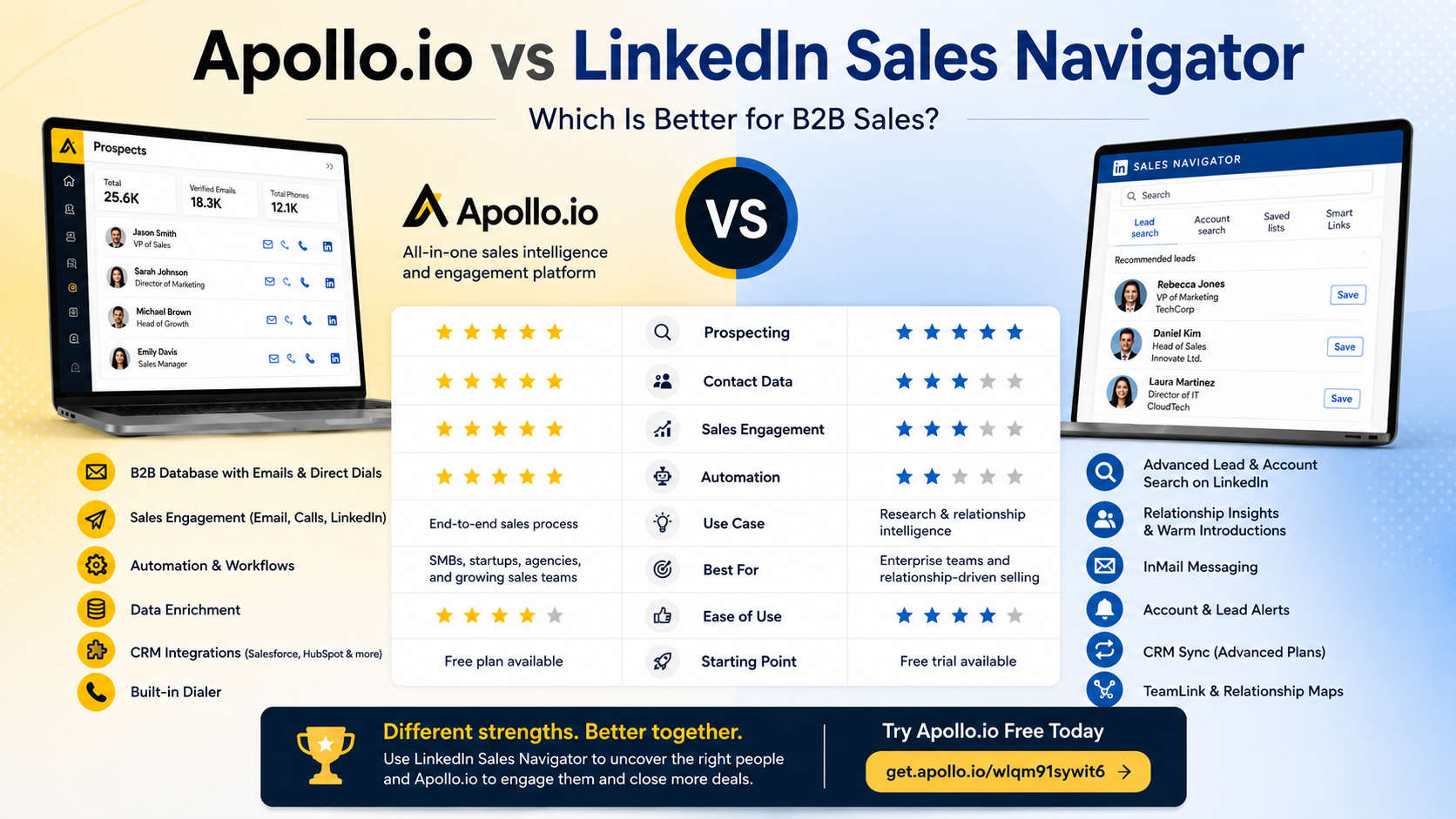
If you work in B2B sales, there's a good chance you've heard of both Apollo.io and LinkedIn Sales Navigator.
Both platforms can help sales teams identify potential customers, research accounts, and build better prospect lists. But despite some overlap, they aren't really the same type of tool.
LinkedIn Sales Navigator is built around LinkedIn's professional network and is particularly strong for discovering decision-makers, monitoring accounts, identifying relationship opportunities, and researching prospects.
Apollo goes considerably further into sales intelligence and sales engagement by combining a B2B database with prospecting, enrichment, sequences, calls, workflows, and other sales tools.
So which should your business choose?
Let's compare them.
What Is Apollo.io?
Apollo is a B2B sales intelligence and engagement platform designed to help teams move from finding prospects to actually engaging them.
The platform combines capabilities such as:
B2B contact and company data
Prospecting and list building
Data enrichment
Email sequences
Calling
Workflow automation
Buying signals
CRM integrations
AI-assisted sales tools
One of the biggest advantages of Apollo is consolidation.
Instead of finding prospects in one application, looking for their contact information somewhere else, and then moving everything into another sales engagement platform, much of that workflow can happen inside one system.
That's an attractive proposition for startups, SMBs, agencies, consultants, and B2B sales teams that don't want an overly complicated sales technology stack.
What Is LinkedIn Sales Navigator?
LinkedIn Sales Navigator is LinkedIn's dedicated sales prospecting platform.
It takes the massive professional network already available through LinkedIn and adds advanced tools designed specifically for sales professionals.
Users can search for leads and accounts using detailed filters, save prospects, monitor updates, receive recommendations, identify relationship paths, and use InMail to communicate with people outside their immediate network.
This is where Sales Navigator really shines.
LinkedIn contains an enormous amount of professional context.
People update their:
Job titles
Employers
Career changes
Locations
Professional interests
Posts
Connections
Sales Navigator turns those signals into prospecting intelligence.
For example, its search capabilities can help identify people who recently changed jobs or posted on LinkedIn, alongside filters around seniority, geography, function, accounts, and other criteria.
Apollo vs LinkedIn Sales Navigator: The Biggest Difference
Here's the simplest way I think about the two platforms:
LinkedIn Sales Navigator helps you understand who you should talk to.
Apollo helps you find those prospects and gives you more of the infrastructure needed to engage them.
That's obviously an oversimplification, but it's an important distinction.
Sales Navigator is heavily focused on prospect intelligence and relationship-based selling within the LinkedIn ecosystem.
Apollo combines prospecting data with a broader sales execution toolkit.
That difference becomes particularly noticeable once you've actually found your prospect.
Which Is Better for Prospecting?
This one is close because both platforms are excellent for prospect discovery—but they approach it differently.
Sales Navigator benefits tremendously from LinkedIn's professional graph.
Its lead and account searches allow sales professionals to narrow down potential buyers using sophisticated criteria and continuously monitor saved leads and accounts.
If I'm researching an organization and trying to understand:
Who is the decision-maker?
Who recently changed roles?
Who is actively posting?
Who might provide a warm introduction?
Sales Navigator can be incredibly valuable.
But Apollo has a different advantage.
Once you've identified your target persona, its business database is designed to help you find relevant companies and contacts while providing contact information that can be used within your broader sales workflow. Apollo also says its data network uses multi-step verification for emails and direct phone numbers.
Winner: Tie — but for different reasons.
Sales Navigator wins for LinkedIn-native professional intelligence.
Apollo wins when prospecting needs to connect directly with sales execution.
Which Is Better for Contact Data?
This is where Apollo has the clearer advantage.
Finding someone's LinkedIn profile is useful.
But eventually, many B2B sales teams need business contact information.
Apollo is fundamentally built around a B2B data network that includes business contact information and company data, with enrichment capabilities that can also feed information into other sales systems.
Sales Navigator isn't primarily designed to be a contact-data provider.
Its strength is the LinkedIn network itself.
Winner: Apollo
Which Is Better for Sales Engagement?
Again, I'd give this category to Apollo.
Its engagement functionality supports multi-step sequences incorporating emails, calls, LinkedIn tasks, and other touchpoints. The platform also includes a dialer and workflow capabilities for automating parts of the sales process.
That means a sales rep can potentially:
Find a prospect.
Research the account.
Add the prospect to a list.
Add them to an appropriate sales workflow.
Manage follow-up tasks.
Make calls.
Track engagement.
All within the same ecosystem.
Sales Navigator provides InMail and LinkedIn-focused engagement capabilities, but it isn't trying to be the same kind of multichannel sales engagement platform. Core, Advanced, and Advanced Plus currently include InMail alongside features such as saved leads, account lists, alerts, and advanced search.
Winner: Apollo
Which Is Better for Relationship Selling?
Here's where Sales Navigator fights back.
Sometimes selling isn't about putting someone into a sequence.
Especially with enterprise sales, understanding relationships can be enormously valuable.
Sales Navigator includes tools such as Relationship Explorer, Relationship Maps, TeamLink, lead recommendations, account insights, and alerts designed to help sellers understand buying committees and find warmer paths into accounts.
If you're selling a six-figure enterprise solution, that context can be more valuable than simply having someone's email address.
You might discover that someone on your team already knows the prospect.
Or that a decision-maker recently moved companies.
Or that someone within the buying committee has become active on LinkedIn.
Those are powerful signals.
Winner: LinkedIn Sales Navigator
What About CRM Integrations?
Both platforms can fit into a CRM-centric sales stack.
Apollo provides native integrations with HubSpot and Salesforce and can connect with additional tools through integrations such as Zapier.
LinkedIn Sales Navigator also offers CRM capabilities, although some of its deeper CRM functionality is tied to higher-tier plans. For example, LinkedIn documents CRM Sync and related features such as CRM data validation, auto-saving, writeback, and contact creation for supported setups.
I wouldn't necessarily choose between the two based solely on CRM connectivity.
Instead, I'd think about what role each platform needs to play alongside your CRM.
Which Is Better for Small Businesses?
For many SMBs, I'd lean toward Apollo.
Why?
Because smaller companies usually don't want to buy six different sales tools.
They want one platform that can handle as much of the process as reasonably possible.
With Apollo, you can bring prospecting, contact data, enrichment, engagement, workflows, calling, and CRM connectivity closer together.
That's a compelling value proposition for a lean sales team.
Winner: Apollo
Which Is Better for Enterprise Sales?
For large-account relationship selling, Sales Navigator becomes much more compelling.
Enterprise sales teams frequently need to understand complicated buying committees involving:
Executives
Champions
Influencers
Technical stakeholders
Procurement
Finance
End users
Sales Navigator's relationship and account intelligence capabilities are particularly useful in that environment.
Its higher-tier CRM functionality can also make it more deeply integrated into enterprise sales operations.
Winner: LinkedIn Sales Navigator for relationship-heavy enterprise selling.
Do You Actually Need Both?
This is where the comparison gets interesting.
For some businesses, Apollo vs LinkedIn Sales Navigator isn't really an either/or decision.
They can complement each other extremely well.
Imagine this workflow:
Use Sales Navigator to identify companies, understand buying committees, research decision-makers, and monitor professional signals.
Then use Apollo to enrich prospect data, find business contact information, organize prospects, and manage broader sales engagement.
In fact, Apollo specifically offers prospecting capabilities through its Chrome extension, including when working with LinkedIn.
That creates a powerful combination:
LinkedIn provides the professional context.
Apollo provides much of the sales execution infrastructure.
For serious B2B prospecting teams, using both can make more sense than forcing one platform to do everything.
My Verdict: Apollo or LinkedIn Sales Navigator?
If I could only choose one for a typical SMB or growing B2B sales team, I'd start with Apollo.
It's simply broader.
You get prospecting data plus sales engagement capabilities, enrichment, automation, calling, and integrations in one environment.
If my sales strategy were heavily focused on strategic accounts, relationship selling, buying committees, and LinkedIn-based research, I'd strongly consider Sales Navigator.
And if I were building a mature B2B sales operation?
I'd consider using both.
Sales Navigator can help you deeply understand who you want to reach and what's happening around that person or account.
Apollo can help turn that intelligence into an actionable sales process.
Final Thoughts
The question isn't necessarily whether Apollo is better than LinkedIn Sales Navigator.
The better question is:
What problem are you trying to solve?
If you primarily need LinkedIn-native prospect research, relationship intelligence, account monitoring, and advanced lead discovery, Sales Navigator is difficult to ignore.
If you want a broader platform that combines B2B data, contact information, enrichment, prospecting, engagement, calling, and automation, Apollo is the stronger all-in-one option.
And if your sales organization needs both deep professional intelligence and a scalable engagement engine, the strongest answer may simply be:
Use them together.
If you're ready to explore a platform that brings prospecting data and sales engagement together, take a look at Apollo and see whether it fits your B2B sales process.
If you need help setting up Apollo, get in touch with me.