
Commerce Hub Is Now Revenue Hub: What Changed?
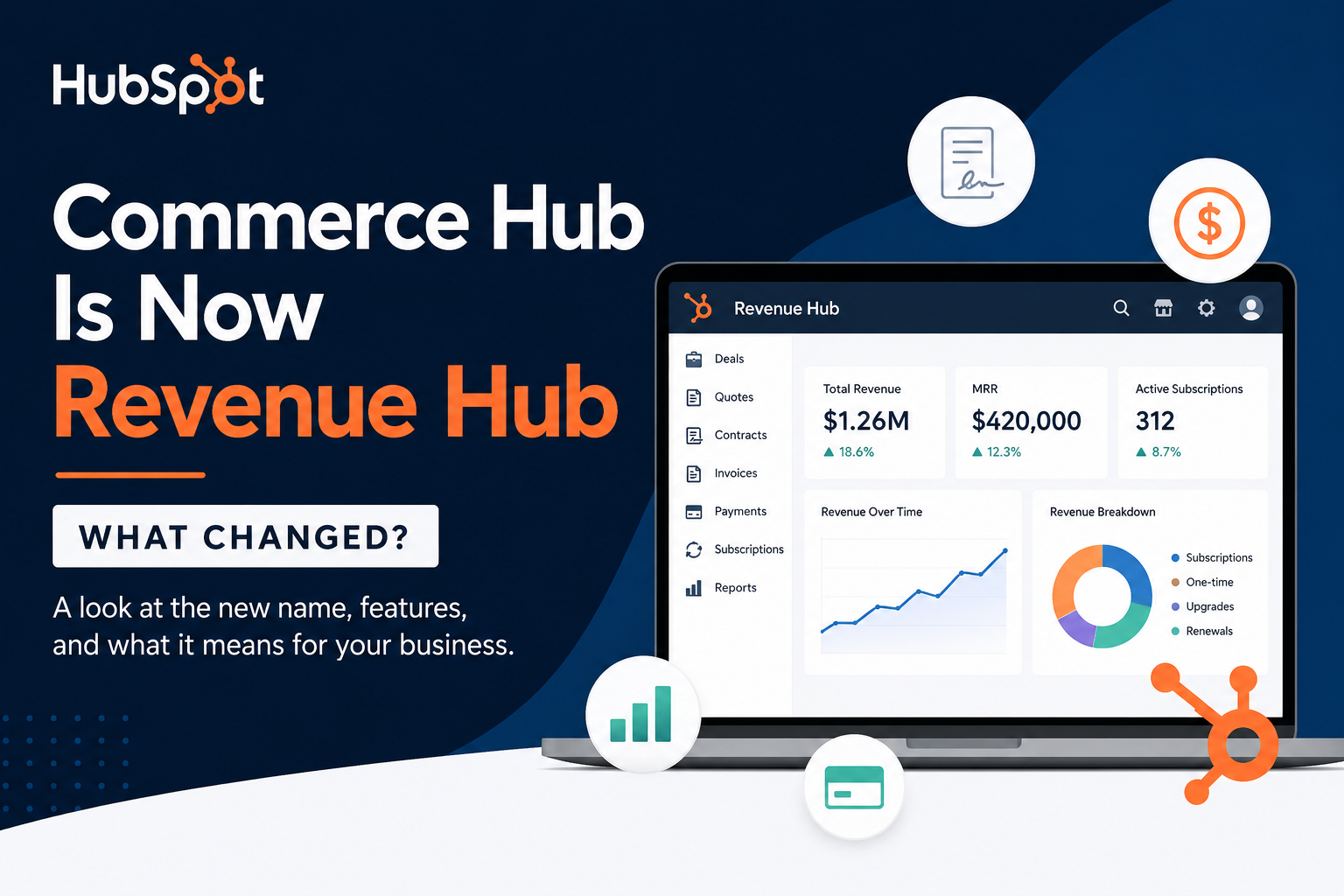
If you've logged into HubSpot recently, you may have noticed something different: Commerce Hub is now Revenue Hub.
At first glance, it might seem like a simple rebrand. But in reality, this change reflects HubSpot's much broader vision of helping businesses manage the entire revenue lifecycle, not just payments and invoices.
So what actually changed? And should your business care?
Let's break it down.
Why Did HubSpot Rename Commerce Hub to Revenue Hub?
When HubSpot originally launched Commerce Hub, its focus was helping businesses:
Create quotes
Accept payments
Manage invoices
Handle subscriptions
Those capabilities are still there—but businesses have evolved.
Today, companies need much more than payment processing. They need a complete system that connects:
Sales
Contracts
Billing
Renewals
Revenue forecasting
Customer data
That's exactly why HubSpot introduced Revenue Hub. Instead of focusing on commerce transactions alone, the platform now supports the entire quote-to-cash process inside HubSpot.
If you'd like to explore Revenue Hub yourself, you can learn more here.
What Stays the Same?
If you're already using Commerce Hub, don't worry.
Your existing features aren't going anywhere.
Inside Revenue Hub, you'll still have access to:
Quotes
Products
Payment Links
Invoices
Subscriptions
Stripe integration
Commerce analytics
The rename doesn't remove functionality—it expands it.
What's New in Revenue Hub?
Here's where things get exciting.
1. Revenue Becomes Part of Your CRM
Rather than treating payments as isolated transactions, Revenue Hub connects revenue directly to your CRM.
Sales teams can now view revenue alongside:
Contacts
Companies
Deals
Tickets
Marketing engagement
Customer history
Everything stays connected in one place, giving every team the same view of the customer.
2. Native Contract Management
One of the biggest additions is native contract management.
Instead of storing contracts in another platform or attaching PDFs to deals, Revenue Hub introduces a dedicated Contract object that lives alongside your CRM records.
That means less manual work, better visibility, and easier collaboration between sales, operations, and finance.
3. Smarter CPQ (Configure, Price, Quote)
HubSpot has expanded its CPQ capabilities to better support growing sales teams.
New improvements include:
Price Books
Enhanced quote management
Greater pricing flexibility
AI-assisted quote creation
These additions make Revenue Hub a much stronger solution for businesses with more complex sales processes.
4. Better Revenue Reporting
Subscription businesses and service organizations can now gain deeper insights into recurring revenue.
Revenue Hub makes it easier to monitor metrics such as:
Monthly Recurring Revenue (MRR)
Annual Recurring Revenue (ARR)
Contract Value
Renewals
Expansions
Instead of building complicated custom reports, many of these insights are now available directly within HubSpot.
5. Everything Lives in One Platform
Perhaps the biggest improvement isn't just a new feature.
It's consolidation.
Instead of relying on separate tools for:
Quotes
Contracts
Billing
Payments
CRM
Revenue Hub brings them together into a single connected platform.
The result is fewer integrations, less manual data entry, and much better visibility across your customer lifecycle.
Why This Matters
Many CRMs stop being useful once a deal closes.
HubSpot wants to continue adding value long after the sale.
With Revenue Hub, businesses can manage the entire customer journey:
Lead → Opportunity → Quote → Contract → Invoice → Payment → Renewal → Expansion
Instead of jumping between disconnected systems, your sales, marketing, finance, and customer success teams can all work from the same source of truth.
Who Should Use Revenue Hub?
Revenue Hub is a great fit for organizations that:
Create proposals or quotes
Invoice customers
Offer subscriptions
Sell recurring services
Need contract management
Want better revenue forecasting
Already use HubSpot CRM
If your business is juggling multiple disconnected systems, Revenue Hub can simplify your operations and provide better visibility into every stage of the customer lifecycle.
Is Revenue Hub Worth It?
In my opinion, yes.
This isn't just a cosmetic name change.
The move from Commerce Hub to Revenue Hub reflects HubSpot's evolution into a true revenue platform that connects sales, finance, operations, and customer success.
If you're already using HubSpot, you'll benefit from a more unified way to manage quoting, contracts, billing, subscriptions, and revenue reporting.
And if you're considering HubSpot for the first time, Revenue Hub is another compelling reason why the platform continues to stand out as one of the best all-in-one CRM solutions available today.
Ready to explore everything Revenue Hub has to offer?
👉 Learn more about Revenue Hub and see how it can help your business grow.