
HubSpot Content Hub Starter: Is It the Right Content Platform for Your Business?
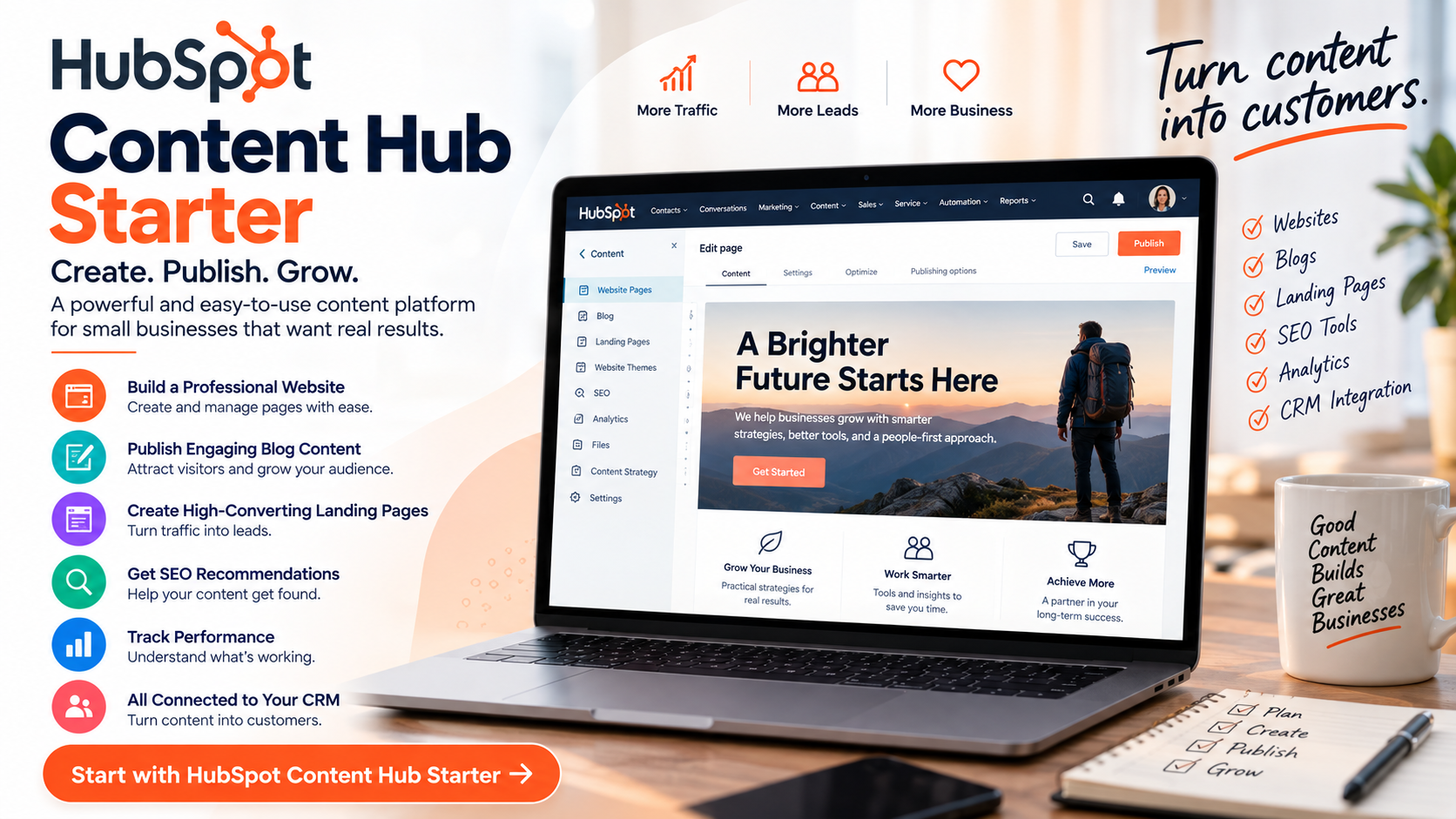
Creating content for your business sounds straightforward.
Build a website. Publish some blog posts. Create landing pages. Optimize everything for search engines. Track traffic. Generate leads.
But as your business grows, those individual activities can quickly turn into a collection of disconnected tools.
That's where HubSpot Content Hub Starter becomes interesting.
It's designed as an entry-level paid content platform for small businesses and growing teams that want more professional content-management capabilities without immediately jumping into an expensive enterprise-level CMS.
Content Hub combines website management, blogging, landing pages, analytics, SEO recommendations, AI-assisted tools, and CRM-connected content within the broader HubSpot ecosystem.
So, what exactly do you get with Content Hub Starter, and who should consider it?
Let's take a closer look.
What Is HubSpot Content Hub?
Content Hub is HubSpot's content marketing and website management platform.
Think of it as the place where your company's digital content can live and be managed.
You can use it for your website, blog, landing pages, and other content while connecting those assets with the customer information stored inside your CRM.
That's an important distinction.
Traditional website platforms are usually excellent at managing pages and posts, but they don't necessarily understand who your visitors are after they become leads.
With HubSpot, your content can exist within the same broader ecosystem as your contacts, forms, marketing, sales activities, and customer data.
Instead of thinking only about publishing content, you're thinking about how content contributes to the entire customer journey.
What Do You Get With Content Hub Starter?
Content Hub Starter sits between the free tools and the significantly more advanced Professional edition.
It gives small businesses many of the essential capabilities they need to establish a professional online presence without paying for features designed for larger content teams.
One of the biggest upgrades from the free tier is removing HubSpot branding from your content. Starter also expands blogging significantly: the current pricing comparison lists one blog with up to 10,000 posts, 20 authors, and 50 tags.
You also get up to 30 landing pages with custom templates and no platform branding, basic SEO recommendations, website traffic analytics, and expanded reporting dashboards.
Starter currently includes 500 HubSpot Credits per month, which can be used by eligible AI-powered features.
For a small business, that's a surprisingly capable starting point.
Build a Professional Business Website
Your website is often the first interaction someone has with your company.
Content Hub gives businesses a visual website-building environment rather than requiring every page to be coded manually.
That makes it particularly attractive for small businesses without dedicated web-development teams.
A marketing employee, business owner, or consultant can manage pages and make routine changes without needing to contact a developer every time a headline needs updating.
And because your website is connected to HubSpot, it can become part of a larger lead-generation system rather than simply functioning as an online brochure.
A visitor discovers your website.
They read an article.
They visit a service page.
They complete a form.
They become a contact.
Your content and customer data can work together.
Create and Manage a Business Blog
Blogging remains one of the most useful reasons to consider Content Hub Starter.
You could publish educational articles, company announcements, industry insights, tutorials, case studies, and other resources directly through the platform.
For example, imagine you're an IT consulting company.
You might publish articles such as:
"5 Signs Your Business Needs a Microsoft 365 Security Assessment"
Someone searching for that problem discovers your article, learns from your expertise, and eventually submits a form asking about your services.
That's where content marketing becomes lead generation.
Content Hub Starter currently supports one blog on the same subdomain as your website and up to 10,000 blog posts, which should be more than enough for most small-business content strategies.
Create Landing Pages
Landing pages are another valuable feature.
Instead of sending every visitor to your homepage, you can create dedicated pages for individual campaigns.
You could build landing pages for a downloadable guide, webinar, consultation request, newsletter subscription, service promotion, or event registration.
Content Hub Starter currently allows up to 30 landing pages, supports custom templates, and removes platform branding.
For a small business running a handful of campaigns, 30 pages can provide plenty of room to experiment without immediately requiring the Professional tier.
SEO Tools Are Built In
Publishing great content doesn't accomplish much if nobody discovers it.
Content Hub includes SEO recommendations that can help identify opportunities to improve your website and content for search engines.
The Starter edition provides basic SEO recommendations. More sophisticated capabilities—including advanced recommendations, full site auditing, and topic tools—are reserved for higher tiers.
That distinction is important.
I wouldn't buy Starter expecting an enterprise-level SEO platform.
But if you're a small business trying to establish good SEO fundamentals while creating your website and blog, having recommendations inside the same environment where you publish your content is convenient.
Content Connected to Your CRM
This is probably the biggest reason I'd consider HubSpot instead of evaluating Content Hub purely as another website builder.
The CRM connection changes the equation.
A traditional CMS knows that your page received 500 visits.
A CRM-connected content strategy can potentially help you understand how website activity relates to actual contacts and customer journeys.
The broader platform includes contact management, forms, analytics, deal pipelines, and other business tools, while Content Hub focuses on creating and managing the content that attracts those customers.
That becomes increasingly useful as your company grows.
Your website isn't isolated from the rest of the business.
It becomes part of your customer system.
Reporting and Analytics
Content Hub Starter also gives you tools for monitoring your content.
The current plan comparison includes standard website traffic analytics and up to 30 reporting dashboards with 50 reports per dashboard on Starter.
That can help you start answering practical questions:
Which pages attract visitors?
Which articles are performing?
Where is your traffic coming from?
Are people engaging with the content you're producing?
Small businesses don't necessarily need incredibly sophisticated analytics from day one.
They need enough information to determine what's working and where they should invest more effort.
What About AI?
AI has become an increasingly important part of the HubSpot ecosystem.
The company now positions Content Hub as an AI-powered content creation and CMS platform, with capabilities across content creation, optimization, and management.
However, don't assume every AI feature advertised for Content Hub is included in Starter.
Some of the more sophisticated functionality is limited to Professional or Enterprise, while certain AI-powered capabilities use credits.
As mentioned earlier, Starter currently includes 500 credits each month, and unused credits don't roll over to the following month.
That's another reason to compare the specific features you need rather than purchasing based purely on the overall product marketing.
How Much Does Content Hub Starter Cost?
Pricing deserves a little caution because HubSpot regularly runs promotions and offers different billing options.
As of September 2026, the official pricing page is showing promotional Starter pricing beginning at $7 per month per seat for eligible annual purchases, compared with the standard $20-per-seat monthly figure displayed on the page.
The official product catalog lists Content Hub Starter as starting at $20 per month per seat before promotional pricing.
Because promotions can change, I wouldn't hard-code the discounted price into a long-term budget.
Check the current offer when you're ready to subscribe.
Who Should Use Content Hub Starter?
I think Content Hub Starter makes the most sense for small businesses, consultants, startups, and growing companies that want to move beyond a basic website but aren't ready for an advanced content marketing platform.
It's particularly attractive if you're already using—or planning to use—other HubSpot tools.
That's where the value becomes much clearer.
Instead of having your website on one platform, forms somewhere else, CRM in another system, and reporting scattered between applications, you can gradually consolidate more of that customer journey.
When Should You Consider Professional Instead?
Starter isn't designed to provide everything.
Content Hub Professional is aimed at organizations with more sophisticated content operations.
For example, the Professional tier introduces capabilities such as advanced SEO recommendations and site auditing, content remix, significantly broader content management features, and more advanced tools for scaling content production.
If you're managing a serious content operation across multiple teams and channels, Starter may eventually feel restrictive.
But that's exactly why Starter exists.
You don't need to purchase the advanced platform before you actually need it.
Final Thoughts
HubSpot Content Hub Starter occupies an interesting middle ground.
It's more professional and capable than relying exclusively on free content tools, but it's considerably more accessible than jumping directly into the Professional or Enterprise tiers.
You can build and manage a website, publish a substantial blog, create landing pages, remove platform branding, use basic SEO recommendations, monitor website performance, and connect your content to a much larger CRM ecosystem.
For me, that last point is the real selling proposition.
You're not simply buying a place to publish articles.
You're building content inside a system that can eventually connect marketing, sales, customer data, and the customer journey.
For a small business that wants room to grow, HubSpot Content Hub Starter is certainly worth considering.
If you need help setting up HubSpot, get in touch with me.