
What's a CRM? And Why Should Every Business Have One?
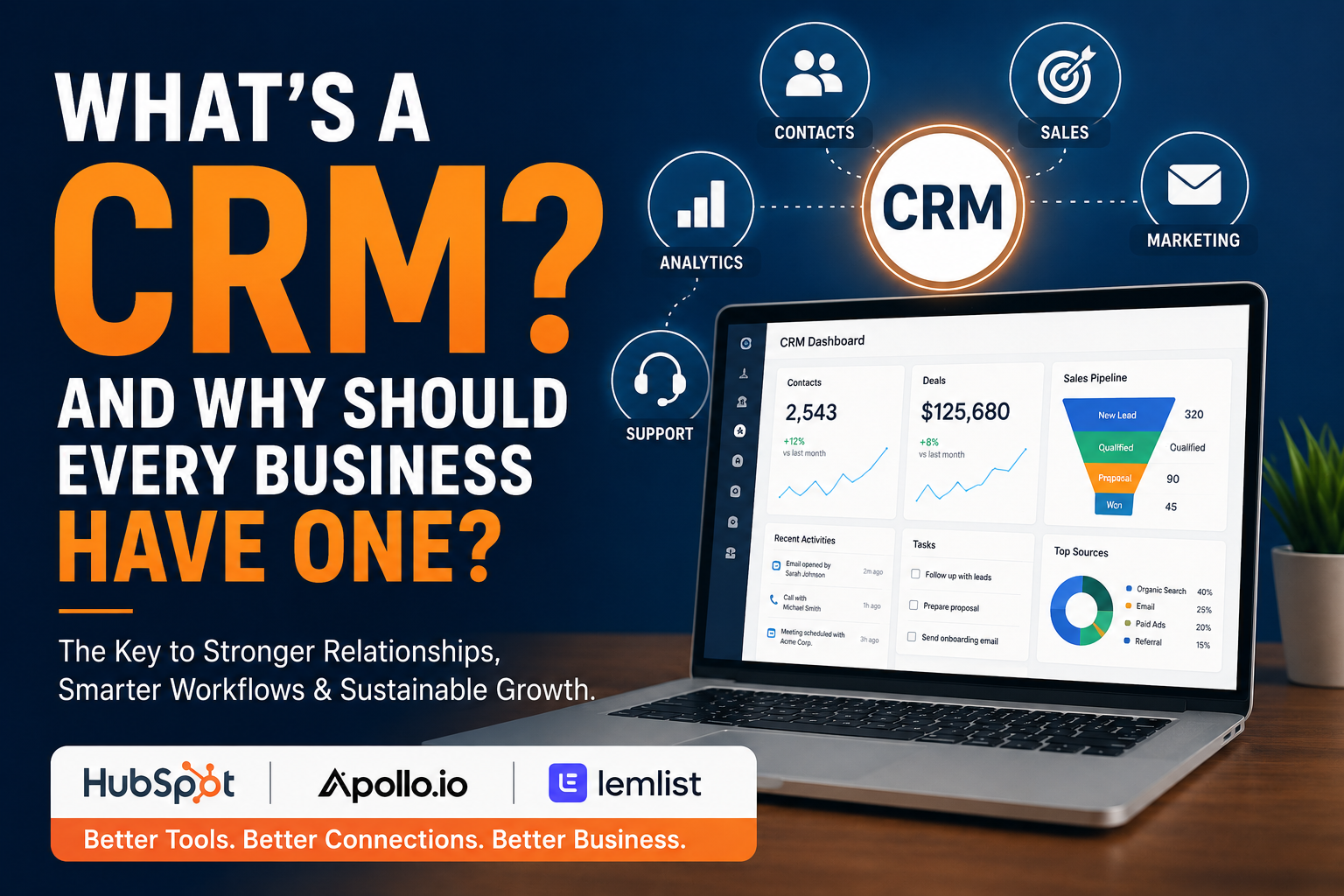
If you've ever forgotten to follow up with a prospect, searched through hundreds of emails looking for a customer's phone number, or wondered where your next sale is coming from, you're not alone.
These are some of the most common growing pains businesses experience—and they're exactly why Customer Relationship Management (CRM) software exists.
Whether you're a solo entrepreneur, a small business owner, or leading a large organization, a CRM can fundamentally change how you attract customers, nurture relationships, close deals, and grow your business.
In this guide, we'll explore what a CRM is, why every business should have one, and which platforms are worth considering.
What Is a CRM?
CRM stands for Customer Relationship Management.
At its simplest, a CRM is software that helps businesses organize customer information.
But today's CRMs do much more than store names and email addresses.
Modern CRM platforms allow you to:
Store contacts and companies
Track every interaction with customers
Manage your sales pipeline
Send marketing emails
Build landing pages and forms
Automate repetitive tasks
Schedule follow-ups
Create reports and dashboards
Measure marketing ROI
Forecast revenue
Instead of using spreadsheets, sticky notes, inboxes, and disconnected software, everything lives in one centralized platform.
Why Every Business Needs a CRM
1. You Never Lose Track of a Customer Again
One of the biggest challenges growing businesses face isn't generating leads.
It's managing them.
Without a CRM, customer information often ends up scattered across:
Email inboxes
Excel spreadsheets
Phone contacts
Business cards
Slack conversations
Contact forms
Eventually someone forgets to follow up.
Potential customers move on.
Revenue is lost.
A CRM ensures every lead is captured, organized, and assigned to the right person.
2. Your Entire Team Works From the Same Information
Imagine asking questions like:
Who last spoke with this customer?
When was the proposal sent?
Which emails have they opened?
What products are they interested in?
Which marketing campaign brought them here?
Without a CRM, answering these questions often requires digging through emails and asking multiple team members.
With a modern CRM, every interaction is stored in one timeline that anyone with permission can access.
No more guessing.
No more duplicated work.
3. Marketing and Sales Finally Work Together
Many organizations struggle because marketing and sales operate in separate systems.
Marketing celebrates lead generation.
Sales complains about lead quality.
The disconnect usually comes from incomplete data.
A good CRM connects both departments by showing exactly how prospects move through the customer journey—from first website visit to closed deal.
This creates better collaboration, stronger reporting, and more predictable growth.
4. Automation Saves Time Every Single Day
Think about all the repetitive work your team does each week:
Sending follow-up emails
Assigning leads
Creating tasks
Updating deal stages
Scheduling reminders
Logging meetings
Sending notifications
Modern CRM platforms automate much of this work.
Instead of spending hours on administrative tasks, your team can focus on what really matters: building relationships and serving customers.
5. Better Decisions Through Better Reporting
One of the biggest advantages of using a CRM is visibility.
Instead of making decisions based on assumptions, you gain access to real business data.
Questions that become easy to answer include:
Which marketing campaigns generate the most revenue?
Which salesperson closes deals the fastest?
What's our average sales cycle?
Where are deals getting stuck?
Which customers generate the highest lifetime value?
When your business runs on data instead of guesswork, growth becomes much more intentional.
Why I Personally Recommend HubSpot
I've implemented CRM systems for businesses ranging from small family-owned companies to enterprise organizations with millions of records.
While there are many great CRM platforms available, HubSpot continues to be my recommendation for most businesses.
Why?
Because it does much more than CRM.
With HubSpot, you can manage:
Marketing automation
Sales pipelines
Customer service
Email marketing
Landing pages
Website forms
Reporting dashboards
Live chat
AI-powered tools
Website content
Customer data
Instead of purchasing and integrating several different platforms, everything works together inside one ecosystem.
That simplicity becomes increasingly valuable as your business grows.
Other Excellent CRM Options
While HubSpot is my preferred recommendation, it isn't the only option available.
Here are a few excellent alternatives.
Salesforce
Salesforce is often considered the enterprise leader.
It's incredibly powerful and highly customizable, making it ideal for very large organizations with dedicated CRM administrators.
However, that flexibility also comes with increased complexity.
Microsoft Dynamics 365
Businesses already invested in Microsoft's ecosystem often choose Dynamics.
It integrates well with Microsoft 365, Outlook, Teams, and Power BI.
Zoho CRM
Zoho offers excellent value for smaller organizations looking for an affordable yet capable CRM platform.
Pipedrive
Pipedrive focuses heavily on sales pipeline management and simplicity.
It's especially popular among smaller sales teams.
A CRM Is Just the Beginning
A CRM should be the center of your sales and marketing ecosystem.
But it's even more powerful when paired with specialized tools.
Apollo: Find Better Prospects
One tool I frequently recommend alongside a CRM is Apollo.
Apollo helps businesses:
Find decision-makers
Build targeted prospect lists
Enrich company data
Identify buying signals
Manage outbound prospecting
Instead of spending hours researching potential customers manually, Apollo dramatically accelerates the prospecting process.
For B2B businesses, it's one of my favorite sales intelligence platforms.
Lemlist: Build Personalized Outreach
Finding prospects is only half the battle.
Building meaningful relationships requires thoughtful communication.
That's where Lemlist comes in.
Lemlist helps businesses create highly personalized email campaigns with:
Personalized images
Dynamic variables
Multi-step sequences
LinkedIn touchpoints
Deliverability-focused sending
When used responsibly, it can help businesses engage prospects more effectively while maintaining a personal touch.
Signs You've Outgrown Spreadsheets
If any of these sound familiar, it's probably time to invest in a CRM:
Customer information is stored in multiple places.
You forget to follow up with leads.
Sales reports take hours to create.
Marketing and sales don't share data.
Team members ask the same customers the same questions.
You're growing faster than your current systems can handle.
A CRM doesn't just organize your business.
It prepares your business to scale.
Final Thoughts
No matter what industry you're in, relationships are at the heart of every successful business.
A CRM helps you manage those relationships more effectively by bringing together your contacts, conversations, marketing, sales, and reporting into one place.
For most growing businesses, I believe HubSpot offers one of the best balances of usability, scalability, automation, and value available today.
And if you're looking to build a modern revenue engine, pairing HubSpot with Apollo for prospecting and Lemlist for personalized outreach creates a powerful toolkit that can support your business from its first customer to thousands more.
The best CRM isn't simply the one with the most features.
It's the one your team actually uses every single day—and the one that helps you build stronger, longer-lasting customer relationships.
Need Help Choosing or Implementing a CRM?
Whether you're evaluating HubSpot, migrating from another platform, or looking to improve your existing CRM strategy, I'd be happy to help.