
Why Email Warm-Up Matters for Better Email Deliverability
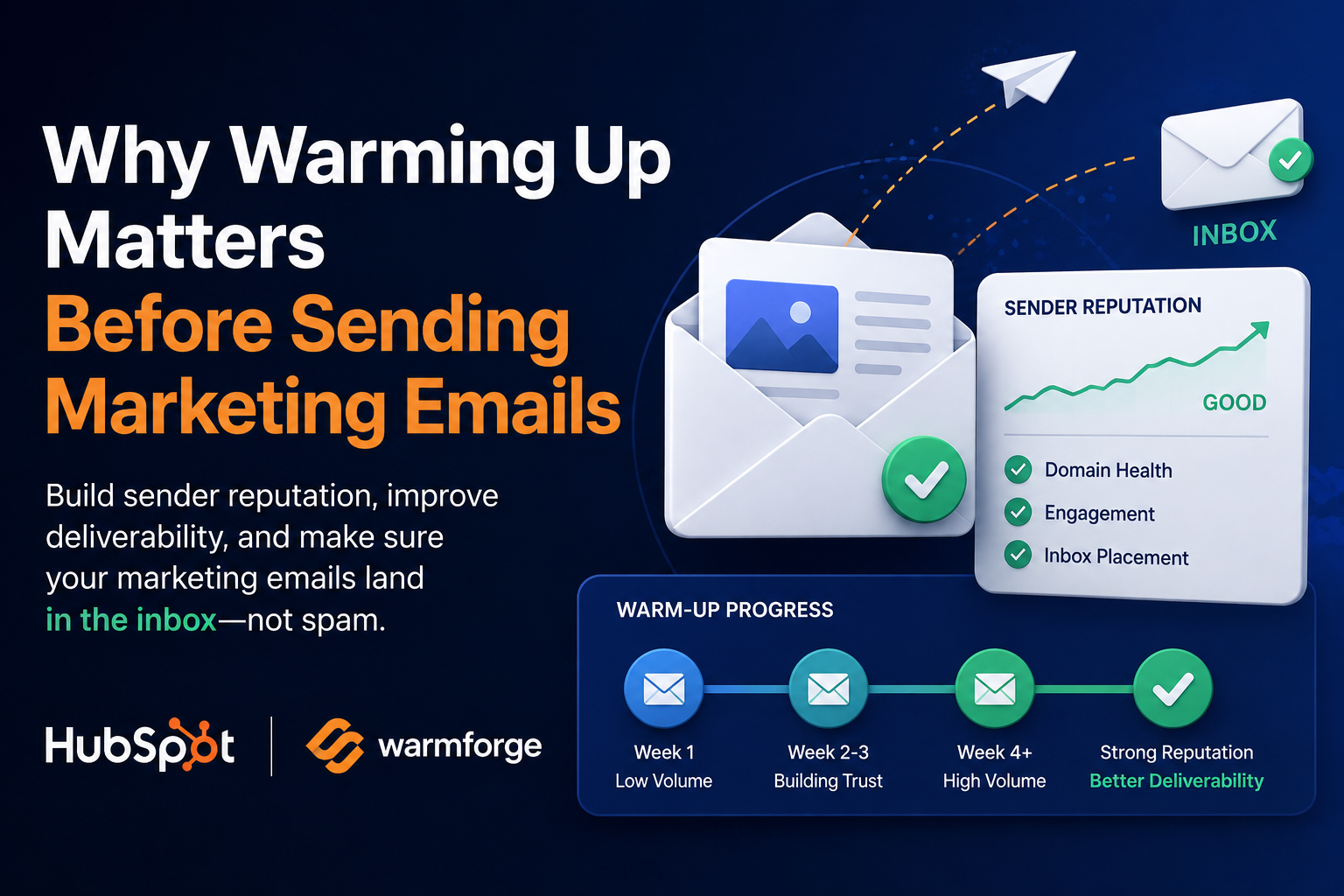
Whether you're sending marketing newsletters, customer updates, onboarding emails, or sales communications, one thing remains true:
If your emails don't reach the inbox, they can't achieve their purpose.
Many businesses spend countless hours designing beautiful email templates, writing compelling copy, and building sophisticated automation workflows—only to discover that a significant portion of their emails are ending up in spam or never reaching recipients at all.
One of the most overlooked contributors to strong email performance is email warm-up.
If you're investing in email marketing, automation, or customer communication, maintaining a healthy sender reputation should be just as important as creating great content.
Disclaimer: This blog article and its recommendations are focused on email warming-up for "marketing campaigns" or email marketing efforts, not for cold outreach for outbound sales initatives. For the latter, you should ideally NOT use HubSpot, but rather an outbound tool such as Apollo, Lemlist, and you should also utilize secondary email sending domains.
Great Email Marketing Starts With Great Deliverability
I'm a huge believer in HubSpot.
It's one of the best platforms available for managing customer relationships and email marketing, offering features like:
Marketing email automation
Customer segmentation
Lifecycle marketing
Lead nurturing
CRM-powered personalization
Campaign reporting
Customer journeys
I've spent years implementing HubSpot for organizations ranging from startups to enterprise companies because it helps teams build scalable, measurable marketing systems.
However, there's one thing that HubSpot—or any email platform—cannot do on its own:
It can't instantly establish trust with mailbox providers for a new sending domain or inbox.
That trust has to be earned.
What Is Email Warm-Up?
Email warm-up is the process of gradually building a positive sender reputation with email providers like Gmail, Outlook, Yahoo, and Apple Mail.
Instead of suddenly sending hundreds or thousands of emails from a brand-new inbox or domain, the sending volume increases gradually while positive engagement signals are generated over time.
Think of it like building a credit score.
You don't establish financial trust overnight.
Likewise, mailbox providers want to see consistent, healthy sending behavior before they confidently deliver your emails to recipients' primary inboxes.
Why Sender Reputation Matters
Every email you send contributes to your sender reputation.
Mailbox providers evaluate signals such as:
Sending consistency
Engagement rates
Opens
Replies
Spam complaints
Bounce rates
Authentication (SPF, DKIM, and DMARC)
Domain history
These signals help determine whether future emails are delivered to:
✅ Primary Inbox
📂 Promotions
📂 Updates
🚫 Spam
Unfortunately, once a sender reputation is damaged, rebuilding it can take time.
That's why it's far easier to protect your reputation from the beginning than repair it later.
When Should You Warm an Inbox?
Many people assume inbox warm-up is only for outbound sales.
That's simply not true.
Email warm-up is beneficial anytime you're introducing a new sending identity, including:
Launching a new company domain
Creating a new marketing inbox
Switching email platforms
Preparing for a newsletter launch
Increasing email volume significantly
Starting automated lifecycle campaigns
Re-engaging an inactive mailing program
Even organizations sending entirely permission-based marketing emails can benefit from establishing a healthy sender reputation before scaling.
What Happens If You Skip It?
Without a proper warm-up strategy, businesses often experience:
Lower inbox placement
Higher spam rates
Reduced open rates
Poor engagement
Lower campaign performance
Damaged sender reputation
Marketing teams often assume the problem lies with:
Subject lines
Email design
Copywriting
Audience targeting
While those elements matter, none of them can overcome poor deliverability.
If recipients never see your email, even the best campaign cannot succeed.
Why I Recommend Warmforge
One tool I've been recommending is Warmforge.
Warmforge helps automate many of the repetitive tasks involved in building and maintaining a healthy sender reputation by:
Gradually warming new inboxes
Generating healthy engagement signals
Monitoring inbox health
Supporting long-term deliverability
Helping reduce the likelihood of landing in spam
Rather than manually managing the warm-up process, Warmforge works behind the scenes to establish credibility with mailbox providers while you focus on creating valuable content and engaging your audience.
HubSpot + Warmforge: A Stronger Email Strategy
I don't view HubSpot and Warmforge as overlapping products.
They solve different problems.
HubSpot excels at:
CRM management
Marketing automation
Customer segmentation
Email campaigns
Lead nurturing
Analytics and reporting
Customer journey automation
Warmforge focuses on:
Sender reputation
Inbox warm-up
Deliverability
Inbox health
Email trust signals
One helps you build exceptional email campaigns.
The other helps ensure those campaigns actually make it to your audience's inbox.
Together, they create a stronger foundation for successful email marketing.
Best Practices for Healthy Email Deliverability
Whether you're using HubSpot or another email platform, following these best practices can significantly improve deliverability:
Warm up new inboxes gradually.
Authenticate your domain using SPF, DKIM, and DMARC.
Send consistently instead of in unpredictable bursts.
Remove inactive subscribers regularly.
Avoid purchasing email lists.
Monitor bounce and spam complaint rates.
Segment your audience and send relevant content.
Focus on engagement rather than simply increasing send volume.
Deliverability isn't something you configure once—it's something you continuously maintain.
Final Thoughts
The success of your email marketing isn't determined solely by your content.
It's determined by whether your audience actually receives it.
Platforms like HubSpot provide incredible tools for creating personalized, automated customer experiences.
But building a healthy sender reputation is a separate—and equally important—part of the equation.
That's why I recommend pairing a robust marketing platform with an inbox warm-up solution like Warmforge.
One helps you create better emails.
The other helps ensure they reach the inbox.
That's a combination every marketing team can benefit from.
Need Help Improving Your Email Marketing?
Whether you're implementing HubSpot, building marketing automations, improving email deliverability, or optimizing your CRM strategy, I'd be happy to help.