
ActiveCampaign AI Features Explained: Are They Worth Using?
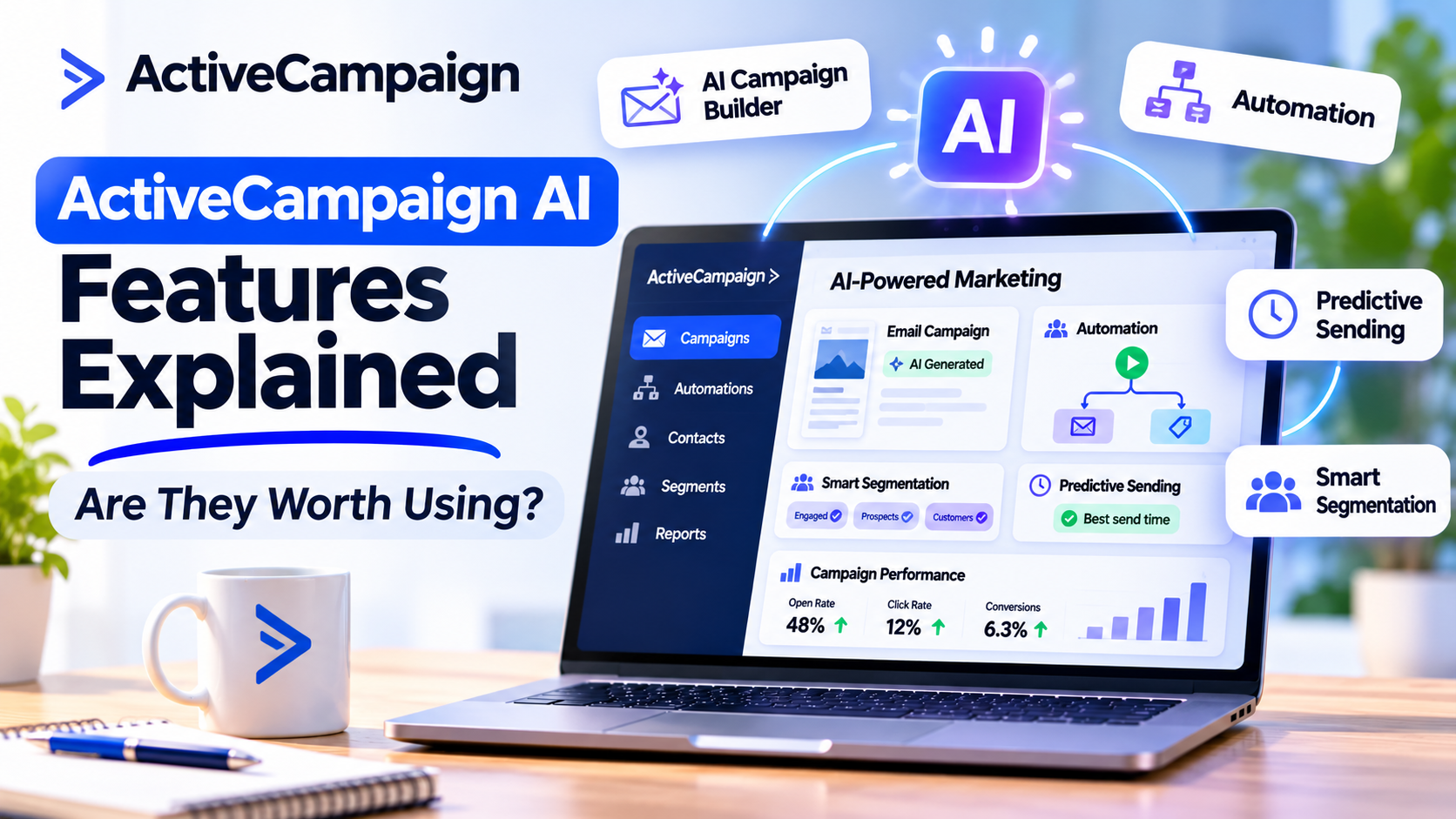
Artificial intelligence is transforming how businesses approach email marketing, customer engagement, and marketing automation.
Not long ago, creating an automated marketing campaign required manually writing emails, building workflows, segmenting contacts, and analyzing performance reports.
Today, AI can help with many of those activities.
But there's an important question every business should ask: Are AI marketing features actually useful, or are they just another software trend?
As a CRM and marketing automation consultant, I believe AI offers significant opportunities for businesses that want to improve marketing productivity without sacrificing personalization.
One platform worth exploring is ActiveCampaign.
In this article, I'll explain its most important AI features, how they work, and whether they're worth using for small businesses, consultants, and marketing teams.
Affiliate disclosure: This article contains affiliate links. I may earn a commission if you sign up through them.
What Is ActiveCampaign AI?
ActiveCampaign is a marketing automation platform that combines email marketing, customer segmentation, automation workflows, and CRM-related capabilities.
Its AI functionality is centered around Active Intelligence, a collection of tools designed to help marketers create campaigns, build automations, understand customer behavior, and optimize results.
Rather than simply generating text, Active Intelligence can use relevant marketing context to assist with campaign planning and analysis.
Its capabilities include:
AI campaign creation
AI-assisted automation building
Predictive email sending
AI-generated content and images
Customer segmentation suggestions
AI Brand Kits
Campaign performance insights
AI-powered workflow actions
Feature availability depends on your subscription and any applicable add-ons.
1. AI Campaign Builder: Create Emails Faster
One of the most practical features is the AI Campaign Builder.
Instead of designing an email campaign entirely from scratch, you can describe your marketing objective in natural language.
For example:
"Create an email campaign promoting a free CRM consultation to small business owners."
The platform can generate a campaign draft that includes a subject line, preheader, email content, layout, images, and call to action.
You can then review and customize the result before sending.
Is It Worth Using?
I think this is particularly valuable for small businesses that don't have a dedicated email marketing team.
However, I wouldn't recommend publishing AI-generated emails without reviewing them.
Your messaging still needs to reflect your brand, audience, and actual offer.
AI should accelerate content creation, not replace your marketing judgment.
2. AI Automation Builder: Simplify Complex Workflows
Marketing automation is one of the areas where AI can provide meaningful productivity improvements.
Traditionally, creating a lead nurturing workflow required manually configuring triggers, conditions, delays, and actions.
With ActiveCampaign, you can use Active Intelligence to describe the automation you want to create.
For example:
"Build a four-email nurturing sequence for prospects who download my marketing automation guide."
The system can help generate a workflow based on your instructions.
You can then inspect the automation, adjust its conditions, and refine the messages.
Is It Worth Using?
Yes, especially when you're creating common workflows such as welcome sequences, lead nurturing campaigns, or customer onboarding.
However, AI-generated automations still require testing.
Before activating any workflow, I recommend checking entry conditions, exit rules, duplicate enrollment, and suppression settings.
A poorly configured automation can create a frustrating customer experience regardless of whether AI helped build it.
3. Predictive Sending: Improve Email Timing
Sending an email at the right time can influence engagement.
But identifying the ideal sending time for every subscriber isn't easy.
Predictive Sending uses historical engagement information to estimate when individual contacts are more likely to open emails.
Instead of delivering every message simultaneously, the platform can adjust delivery timing for eligible campaigns and automations.
Is It Worth Using?
I believe this feature is worth evaluating if you already have an established email list with meaningful engagement history.
However, predictive sending isn't magic.
It needs relevant data, and it won't automatically improve an irrelevant offer or poorly written email.
I recommend comparing results against your existing sending schedule using click rates, conversions, and revenue rather than relying exclusively on open rates.
4. AI-Suggested Segmentation: Reach More Relevant Audiences
Customer segmentation is essential for effective marketing automation.
Sending the same message to every subscriber rarely produces the best customer experience.
Traditionally, marketers build segments using contact properties, tags, purchase history, and engagement behavior.
ActiveCampaign offers AI-assisted segmentation capabilities that can help identify or construct relevant audience groups.
For example, you might ask the platform to identify contacts who engaged with previous campaigns but haven't purchased recently.
Is It Worth Using?
I think segmentation is one of the most promising AI applications.
It can help marketers discover opportunities that might be overlooked when relying entirely on manually created lists.
However, the quality of your segmentation depends on the quality of your customer data.
AI cannot compensate for inaccurate contact records or poorly structured tracking.
5. AI Brand Kit: Maintain Consistent Marketing
Creating marketing content faster is useful, but consistency matters just as much.
The AI Brand Kit helps businesses establish reusable brand information.
By providing your website address, you can import or generate brand details such as logos, colors, fonts, and business descriptions.
This information can help guide the creation of branded email templates and content.
Is It Worth Using?
For consultants, agencies, and small businesses, I think this is a practical feature.
It can reduce repetitive design work and make it easier to maintain a consistent appearance across campaigns.
Still, you should verify the imported information and review generated content for accuracy.
6. Active Intelligence: Ask Questions About Marketing Performance
One of the more interesting capabilities is conversational reporting.
Instead of manually navigating multiple dashboards, marketers can ask questions about campaign performance.
For example:
Which email campaigns generated the most clicks?
How did last month's newsletter perform?
Which campaigns need improvement?
What engagement trends should I investigate?
Active Intelligence can help surface relevant information and recommendations.
The platform also provides proactive insights designed to highlight performance changes and improvement opportunities.
Is It Worth Using?
I believe this can be valuable for business owners who need useful marketing insights without spending hours analyzing reports.
However, I recommend verifying important numbers against your underlying reporting data.
AI-generated recommendations should support decision-making rather than become unquestioned conclusions.
7. AI Actions: More Advanced Marketing Personalization
For businesses with more sophisticated requirements, ActiveCampaign offers an AI Actions Library.
These capabilities can support tasks such as analyzing text, categorizing responses, generating contextual content, and updating contact information within workflows.
Imagine collecting customer feedback through a form.
An AI-assisted workflow could help classify responses and route customers into appropriate follow-up processes.
This creates opportunities for more responsive customer journeys.
However, advanced AI actions may require additional subscriptions or usage-based charges.
I recommend starting with a clearly defined business case before implementing them.
What Are the Limitations of ActiveCampaign AI?
Although the platform offers useful capabilities, there are limitations.
First, AI-generated content requires human review. It can produce generic messaging, incorrect assumptions, or recommendations that don't fit your audience.
Second, data quality matters. Predictive features and segmentation are less useful when customer information is incomplete.
Third, not every AI capability is included in every subscription. Some advanced features require higher-tier plans or add-ons.
Finally, AI doesn't eliminate the need for marketing strategy.
You still need clear objectives, relevant offers, proper consent management, and measurable performance indicators.
Is ActiveCampaign AI Worth It for Small Businesses?
My answer is yes, provided you're using AI to solve real operational problems.
I would prioritize three areas:
Campaign creation: Reduce the time required to prepare email marketing campaigns.
Marketing automation: Build and maintain customer journeys more efficiently.
Segmentation and reporting: Identify opportunities to improve engagement and conversions.
I wouldn't recommend upgrading solely to access every available AI feature.
Instead, identify the activities consuming the most time and evaluate whether AI can improve them.
For example, if your marketing team spends six hours every week creating email campaigns, reducing that workload could create meaningful savings.
But the real return on investment comes from combining time savings with better marketing performance.
My Recommendations for Getting Started
If you're considering AI-powered marketing automation, I recommend starting with a simple implementation plan.
Begin by reviewing your existing contact database and marketing workflows.
Next, choose one repetitive activity that could benefit from AI assistance.
Create a small pilot campaign, review the AI-generated output, and measure the results.
Once you're comfortable with the process, explore more advanced capabilities such as predictive sending, segmentation, and AI-powered workflow actions.
Most importantly, maintain human oversight.
The objective is to make your marketing team more effective, not remove accountability from the process.
Final Thoughts: Are ActiveCampaign AI Features Worth Using?
I believe AI-powered marketing automation is becoming increasingly valuable for businesses that want to improve productivity and create more relevant customer experiences.
What makes ActiveCampaign interesting is that its AI capabilities extend beyond content generation.
The platform combines campaign creation, automation building, predictive sending, segmentation, and performance insights within a connected marketing environment.
However, the best results still depend on having a clear strategy, accurate customer data, and well-designed workflows.
My recommendation is to start with the AI features that address your biggest marketing challenges and expand as you demonstrate measurable value.
If you're looking for a marketing automation platform with integrated AI capabilities, it's worth exploring.
Explore ActiveCampaign's AI Features and discover how artificial intelligence could help your business create smarter marketing campaigns.
If you need help setting up ActiveCampaign, get in touch with me.