
Can Lemlist Replace Multiple Sales Tools?
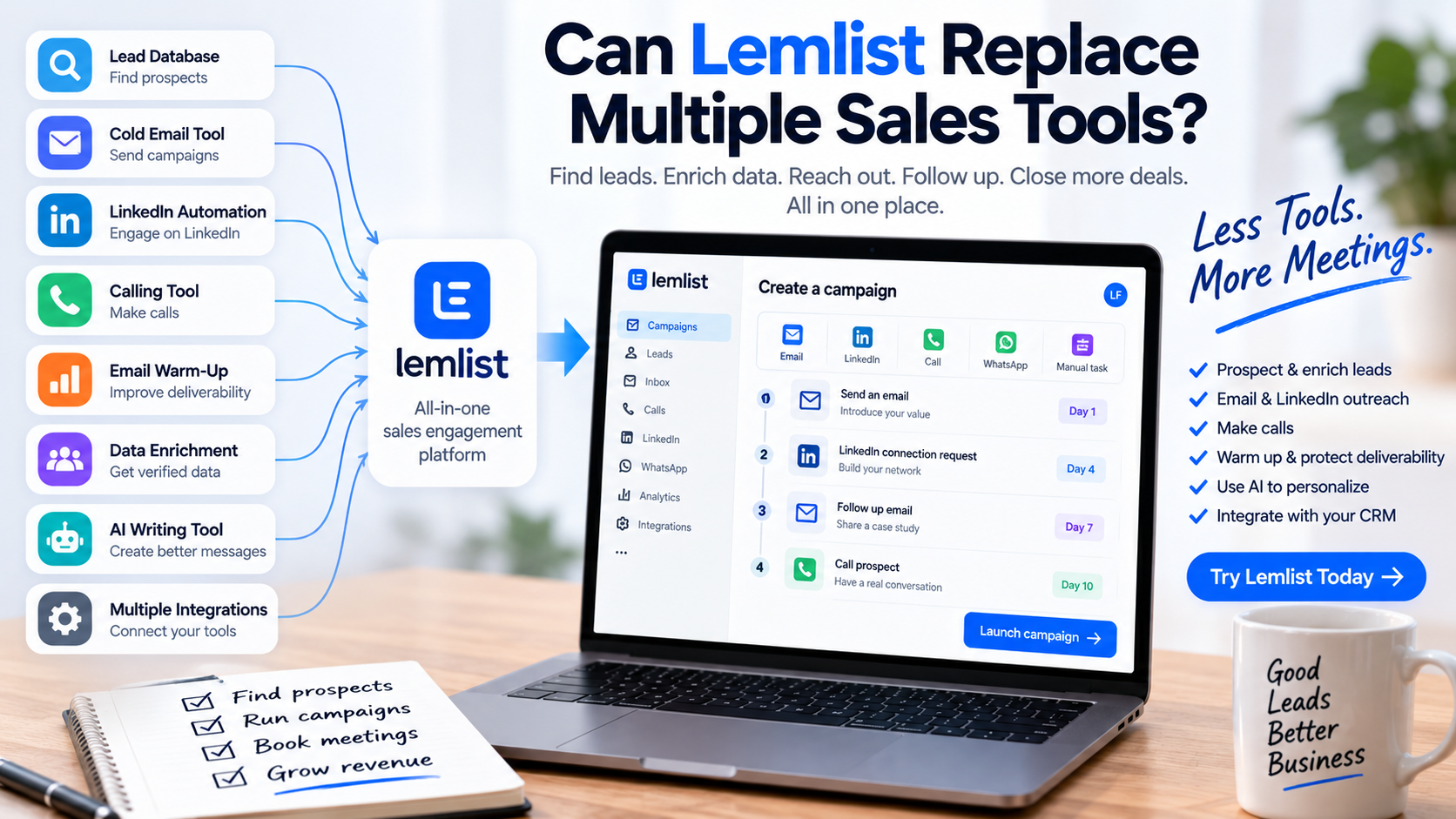
If you're building a B2B sales stack, it's surprisingly easy to end up paying for a long list of tools.
You might have one platform for finding prospects, another for email enrichment, another for cold email sequences, another for LinkedIn outreach, a dialer for calls, an email warm-up tool, and then a CRM sitting behind everything.
Individually, each tool makes sense.
Together, they can become expensive and complicated.
That's one of the reasons Lemlist has become interesting to me. Instead of focusing exclusively on cold email, the platform has expanded into a much broader outbound sales platform covering prospecting, enrichment, multichannel engagement, calling, deliverability, AI, and integrations.
So the question is:
Can Lemlist actually replace several tools in your sales stack?
For many small and growing B2B teams, I think the answer could be yes.
1. It Can Replace a B2B Lead Database
Before you can contact prospects, you need to find them.
Traditionally, this might mean subscribing to a separate sales intelligence or prospecting database and then exporting those leads into your outreach platform.
Lemlist now includes a massive B2B lead database alongside its outreach functionality.
The company currently advertises access to more than 600 million prospects, with its newer product pages citing a database exceeding 650 million leads. Users can search for relevant accounts and prospects, then find or enrich contact information such as verified email addresses and phone numbers.
That means your workflow could look like:
Find prospect → Enrich contact → Add to campaign → Start outreach
All without exporting spreadsheets between several platforms.
For a small sales team, that's a major advantage.
2. It Can Replace a Separate Email Outreach Platform
This is the category where Lemlist originally built much of its reputation.
You can create automated email sequences, schedule follow-ups, personalize messages, A/B test campaigns, and manage outreach from connected sending addresses.
Imagine you send an introductory email.
If the prospect doesn't respond, another email can be scheduled several days later.
If they still don't respond, the sequence continues.
Instead of salespeople manually remembering hundreds of follow-ups, the system handles the repetitive work.
For teams currently paying for a dedicated cold email platform, this alone could eliminate one subscription.
3. It Can Replace Some LinkedIn Automation Tools
Email isn't always enough.
Sometimes a prospect doesn't see your email but notices your LinkedIn connection request.
That's why multichannel outreach has become such an important part of modern B2B prospecting.
With the appropriate plan, Lemlist can incorporate LinkedIn actions directly into an outreach sequence.
Those actions can include profile visits, connection requests, text messages, and even voice-message workflows.
For example:
Day 1: Send email
Day 4: Visit LinkedIn profile
Day 5: Send connection request
Day 8: Follow up by email
Day 12: Send LinkedIn message
That's much more interesting than running one email campaign and an entirely separate LinkedIn campaign that don't know what each other is doing.
4. It Can Replace a Basic Sales Dialer
Here's where things get even more interesting.
Lemlist also offers in-app calling.
Calls can become part of the same sequence as email and LinkedIn activities, and the platform can log call activity and transcripts into a lead's timeline and connected CRM.
A salesperson could therefore move from:
Email → LinkedIn → Phone
without needing three completely disconnected systems.
For companies with sophisticated call-center requirements, a dedicated calling platform may still make sense.
But for a B2B sales team that simply wants calling integrated into its outbound process, having it inside the same platform can remove yet another tool.
5. It Can Replace an Email Warm-Up Tool
Cold email software is useless if your messages consistently land in spam.
Deliverability has become a major part of the outbound technology stack, and many companies pay separately for mailbox warm-up and deliverability monitoring.
Lemlist has built these capabilities into its broader platform through its Deliverability Hub and warm-up infrastructure.
The platform can help teams monitor mailbox and domain health, warm up sending accounts, identify potential deliverability problems, and manage sender health from a centralized environment.
That's important because deliverability shouldn't be something you think about only after your campaigns stop working.
It needs to be part of your outbound infrastructure.
6. It Can Replace Some Data Enrichment Tools
Finding a person's name and company isn't always enough.
You might also need their verified email address, phone number, job information, company information, and additional context before contacting them.
This is another area where Lemlist has expanded.
Its platform includes data enrichment capabilities and AI agents that can pull structured context from sources including LinkedIn, company websites, CRM information, and other connected data.
That data can then help you qualify, segment, and personalize your outreach.
Instead of:
Database → enrichment platform → spreadsheet → outreach platform
you can potentially simplify the workflow considerably.
7. It Can Replace Parts of an AI Sales Assistant
AI is also becoming increasingly embedded into the platform.
Lemlist now uses AI for areas such as prospect research, lead enrichment, segmentation, personalization, intent signals, and outbound messaging.
That doesn't mean you should let AI run your entire sales strategy unsupervised.
I wouldn't.
The best outbound messages still need to sound relevant and human.
But AI can reduce the amount of repetitive research and preparation required before a salesperson contacts someone.
For a small team, that can translate into a lot of saved time.
8. What About WhatsApp and SMS?
This surprised me because most sales engagement platforms still focus primarily on email, LinkedIn, and phone.
Lemlist has expanded its multichannel strategy to include WhatsApp and SMS alongside those traditional channels.
WhatsApp can be particularly valuable for teams selling internationally, where messaging is often a major business communication channel.
It isn't necessarily included in every subscription—the current Multichannel offering treats WhatsApp as a paid add-on—so check your plan before assuming it's included.
Still, the bigger point remains:
One campaign can increasingly coordinate several different ways of reaching the same prospect.
9. Does It Replace Your CRM?
This is where I'd draw the line.
I wouldn't position Lemlist as a complete replacement for a dedicated CRM.
Its strength is outbound sales engagement.
Your CRM should remain the central system for managing customer relationships, opportunities, pipeline, historical customer information, and broader sales operations.
Fortunately, you don't have to choose between them.
Lemlist offers integrations with CRM platforms such as HubSpot, Salesforce, Pipedrive, Zoho CRM, Attio, and others, and its integrations directory extends to hundreds of tools.
I actually think this is the better architecture:
CRM = system of record
Lemlist = outbound engine
Your sales team can run prospecting and engagement while relevant activities sync back to the CRM.
The Biggest Benefit: Fewer Disconnected Tools
For me, the biggest argument isn't that Lemlist has every feature imaginable.
It's consolidation.
Imagine your current stack looks something like this:
Lead database + email finder + cold email platform + LinkedIn automation + dialer + warm-up software + AI personalization tool + CRM
Every additional application means another subscription, another login, another integration, another database, and another potential point of failure.
If Lemlist can handle prospecting, enrichment, email, LinkedIn, calling, deliverability, AI, WhatsApp, SMS, and multichannel sequencing, your stack suddenly becomes much simpler.
And simplicity has value.
Is Lemlist Right for Everyone?
Not necessarily.
A large enterprise may still prefer specialized tools for each stage of its sales process.
A company with an enormous calling operation might want a dedicated dialer.
A sophisticated RevOps team may prefer a specialized enrichment platform.
And an organization with complex customer lifecycle requirements will almost certainly still need a proper CRM.
The goal shouldn't be:
Replace every sales application.
It should be:
Eliminate unnecessary applications without sacrificing the capabilities your team actually needs.
That's a much better way to evaluate your stack.
Final Verdict: Can Lemlist Replace Multiple Sales Tools?
Yes—for the right business.
I think Lemlist is particularly compelling for startups, agencies, consultants, SMBs, and B2B sales teams that don't want to stitch together an unnecessarily complicated outbound stack.
You can potentially consolidate lead prospecting, contact enrichment, cold email, LinkedIn outreach, calling, deliverability, AI-assisted personalization, WhatsApp, SMS, and multichannel campaign management into one environment.
It probably won't replace your CRM.
And it may not replace every specialized sales application used by a large enterprise.
But that's not really the point.
If you're currently jumping between five or six applications just to find a prospect and start a conversation, Lemlist offers a compelling alternative:
Find the right people, enrich their data, reach them across multiple channels, protect your deliverability, and manage the conversation from one platform.
For a growing sales team, having fewer tools to manage may be just as valuable as having more features.
If you need help setting up Lemlist, get in touch with me.