
How to Use Apollo.io for Account-Based Prospecting
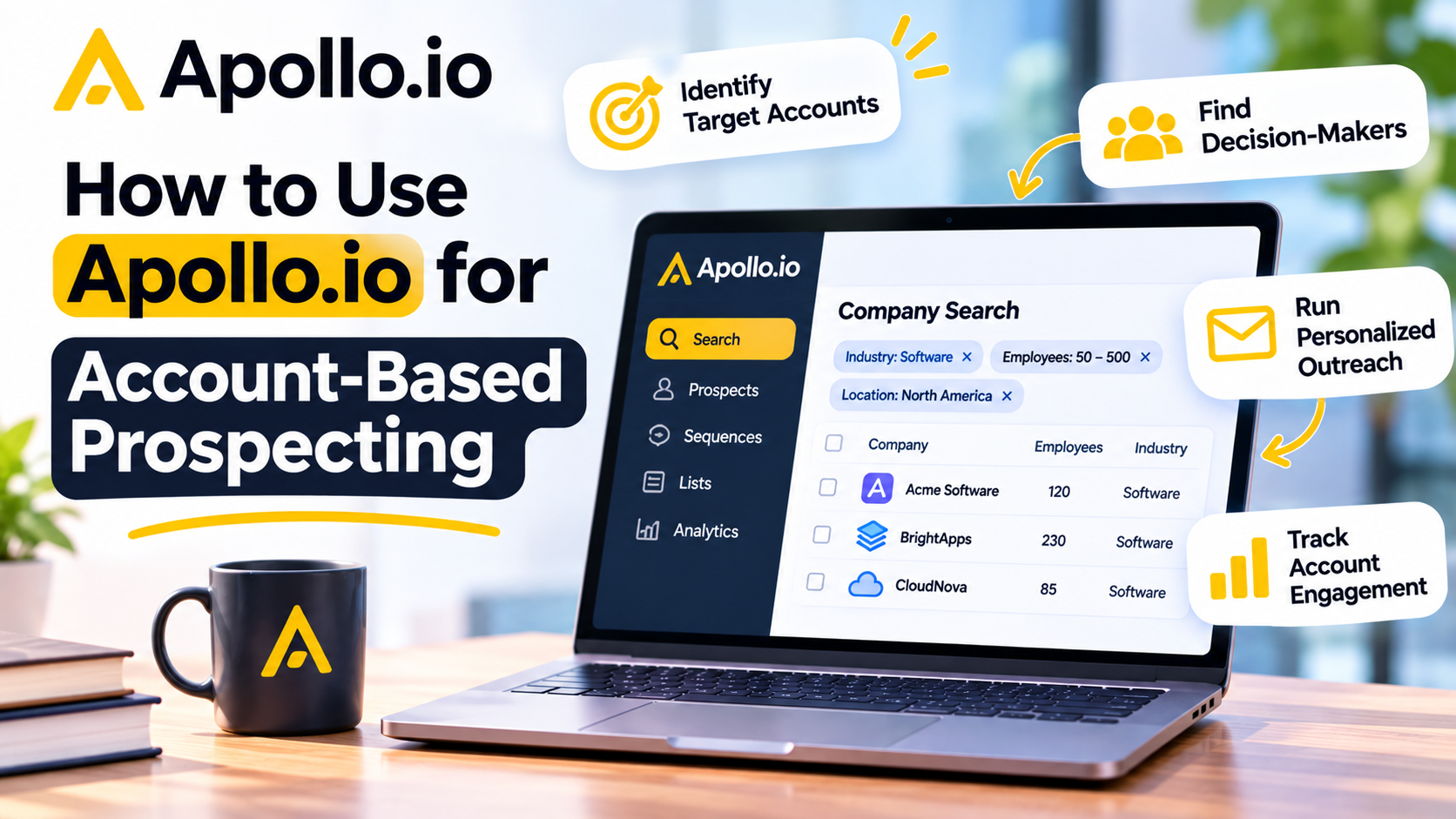
One of the biggest mistakes I see businesses make with B2B prospecting is focusing on finding as many contacts as possible instead of identifying the right companies.
They build massive contact lists, send generic cold emails, and hope someone responds.
But successful B2B sales isn't necessarily about reaching more people. It's about reaching the right people at the right companies with a relevant message.
That's where account-based prospecting comes in.
As a CRM and marketing automation consultant, I believe account-based prospecting is one of the most practical ways to improve outbound sales efficiency.
And one platform I recommend exploring for this strategy is Apollo.io.
With its B2B company database, contact search capabilities, prospecting filters, and sales engagement tools, it can help businesses build a more targeted approach to lead generation.
In this guide, I'll explain how to use it to identify high-value accounts, find decision-makers, and create personalized outreach campaigns.
What Is Account-Based Prospecting?
Account-based prospecting is a B2B sales strategy that focuses on specific companies rather than targeting individual leads at random.
Instead of asking, "Who can I contact?" you start by asking:
"Which companies would be the best customers for my business?"
Once you've identified those organizations, you research the people involved in purchasing decisions and develop outreach strategies tailored to their needs.
For example, imagine you provide CRM implementation services.
Rather than contacting every marketing manager you can find, you might focus on growing B2B companies with 20–200 employees that are expanding their sales operations.
Within each company, you could identify the sales director, marketing director, and operations manager.
This gives you a more strategic approach to prospecting.
Step 1: Define Your Ideal Customer Profile
Before opening Apollo.io, I recommend defining your ideal customer profile (ICP).
Your ICP describes the type of company most likely to benefit from your product or service.
Consider factors such as:
Industry
Company size
Geographic location
Annual revenue
Business model
Technology stack
Growth stage
Common business challenges
For example, a marketing automation consultant might target B2B service companies with 25–150 employees in North America.
These companies may have growing sales teams but lack standardized lead management processes.
The more clearly you define your ICP, the easier it becomes to build a relevant account list.
Step 2: Find Target Companies Using Apollo.io
Once you know what your ideal customers look like, it's time to find companies that match your criteria.
Apollo.io provides company search capabilities that help users identify organizations based on business characteristics.
Start with the company search area and apply relevant filters.
Depending on available data and your subscription, you can narrow your search using criteria such as industry, employee count, location, and other company attributes.
For example, you could search for:
Industry: Professional Services
Company Size: 25–200 employees
Location: United States and Canada
Target: Growing B2B organizations
Instead of exporting thousands of companies immediately, review the results and identify accounts that genuinely match your ICP.
I recommend starting with a manageable list of 25–50 companies.
This makes it easier to research each organization and develop more relevant messaging.
Step 3: Prioritize Your Target Accounts
Not every company that matches your filters deserves the same level of attention.
Some organizations may be a stronger fit because of their size, business model, or potential need for your services.
That's why I recommend creating a simple account prioritization system.
For example:
Tier 1: High-value accounts with a strong fit and a clear potential business need.
Tier 2: Companies that match your ICP but require additional research.
Tier 3: Lower-priority accounts that may become relevant later.
You can organize these accounts using lists in Apollo.io or your CRM.
For more advanced prospecting, you can also consider buying signals and company-level indicators where reliable data is available.
The goal is to focus your research and outreach efforts where they're most likely to create meaningful sales opportunities.
Step 4: Find Decision-Makers at Each Company
One of the biggest advantages of account-based prospecting is that you're not relying on a single contact.
B2B purchasing decisions often involve several stakeholders.
For example, a company considering a new CRM might involve:
A sales director who needs better pipeline visibility.
A marketing director responsible for lead generation.
An operations manager evaluating implementation requirements.
A finance leader reviewing the budget.
With Apollo.io, you can search for contacts associated with your target accounts and filter by job title, seniority, department, and other professional criteria.
This helps you identify people who may influence the purchasing decision.
However, contact databases aren't always perfectly accurate.
I recommend verifying important contact details and checking whether each person's responsibilities are relevant before reaching out.
Step 5: Build Account-Based Contact Lists
After identifying your target companies and stakeholders, organize them into prospecting lists.
Rather than creating one enormous list, group contacts by account priority, industry, or outreach campaign.
For example:
Tier 1 SaaS companies
Professional services companies
Manufacturing businesses
CRM implementation prospects
Within each list, maintain clear information about the company, contact, role, and reason for outreach.
I also recommend documenting the business challenge you're trying to address.
This additional context becomes valuable when personalizing your messages.
Step 6: Personalize Your Outreach Strategy
This is where account-based prospecting becomes significantly different from traditional mass cold email campaigns.
Instead of sending the same message to every prospect, tailor your communication to the company and the stakeholder.
For example, imagine you're contacting a sales director at a growing company.
Your message might say:
"Hi Sarah, I noticed your company is expanding its sales team. Are you currently reviewing how your CRM supports lead assignment, follow-ups, and pipeline reporting?"
For a marketing director at the same company, you might focus on lead nurturing and marketing-to-sales handoffs.
The underlying service is the same.
But the message reflects the recipient's responsibilities.
Apollo.io supports personalized outreach through contact variables and sales engagement sequences.
My recommendation is to use automation for consistency while keeping your messaging relevant and specific.
Never invent company developments or pretend to have researched something you haven't verified.
Step 7: Create a Multistep Sales Sequence
Once your contact lists and messaging are ready, you can build outreach sequences.
Apollo.io includes sales engagement capabilities for organizing email outreach and follow-up activities.
A simple sequence might include:
Day 1: Send a personalized introductory email.
Day 4: Follow up with a relevant business insight.
Day 8: Share a useful resource or example.
Day 12: Send a final, respectful follow-up.
For high-priority accounts, you may also coordinate manual LinkedIn engagement or other appropriate touchpoints.
However, I recommend avoiding excessive outreach to multiple employees at the same organization.
Your goal is to establish a professional relationship, not overwhelm the account.
Also ensure your outreach complies with applicable privacy and anti-spam requirements, including consent obligations where relevant.
Step 8: Connect Prospecting with Your CRM
As a HubSpot Certified Trainer, I strongly recommend keeping your CRM at the center of your sales operations.
Your prospecting platform helps identify potential customers and initiate conversations.
Your CRM should manage the relationships and opportunities that follow.
Apollo.io offers CRM integration capabilities, including connections with HubSpot.
Depending on your configuration, you can synchronize relevant contacts, companies, and sales activities.
Before enabling synchronization, establish clear rules for duplicate management, ownership, and data quality.
This helps prevent your CRM from becoming cluttered with contacts who aren't relevant to your business.
Step 9: Measure Account Engagement
Account-based prospecting requires a different approach to reporting.
Instead of focusing exclusively on the number of emails sent, measure engagement at the account level.
Useful metrics include:
Target accounts contacted
Relevant stakeholders identified
Positive replies
Qualified conversations
Meetings booked
Opportunities created
Pipeline generated
For example, reaching three relevant decision-makers at ten carefully selected companies may produce more valuable conversations than contacting hundreds of poorly matched prospects.
The important thing is to measure the quality of your sales opportunities, not just outreach activity.
Common Mistakes to Avoid
Even with a powerful prospecting platform, your strategy can fail if you make a few common mistakes.
Targeting too broadly: Avoid building lists without a clearly defined ICP.
Contacting only one person: Research the buying committee rather than depending on a single stakeholder.
Using generic messaging: Explain why your offer is relevant to each company.
Ignoring CRM data quality: Establish consistent rules for managing accounts and contacts.
Automating too aggressively: Keep outreach respectful, targeted, and compliant.
Remember that technology supports the process, but it doesn't replace thoughtful sales strategy.
Final Thoughts: Is Apollo.io Good for Account-Based Prospecting?
I think Apollo.io is worth considering for businesses that want to move beyond generic lead generation.
Its combination of company research, contact discovery, prospecting filters, and sales engagement tools makes it useful for building a more structured outbound sales process.
But the real advantage comes from how you use those capabilities.
Start by defining your ideal customer profile.
Identify a manageable list of target accounts.
Research the people involved in purchasing decisions.
Then create personalized outreach that addresses relevant business challenges.
Account-based prospecting isn't about contacting more people. It's about creating better opportunities with the right companies.
If you're ready to build a more targeted B2B prospecting strategy, explore Apollo.io and see how it could support your sales process.
If you need help setting up Apollo, get in touch with me.