
HubSpot AI-Powered CRM: How Artificial Intelligence Is Changing Customer Relationship Management
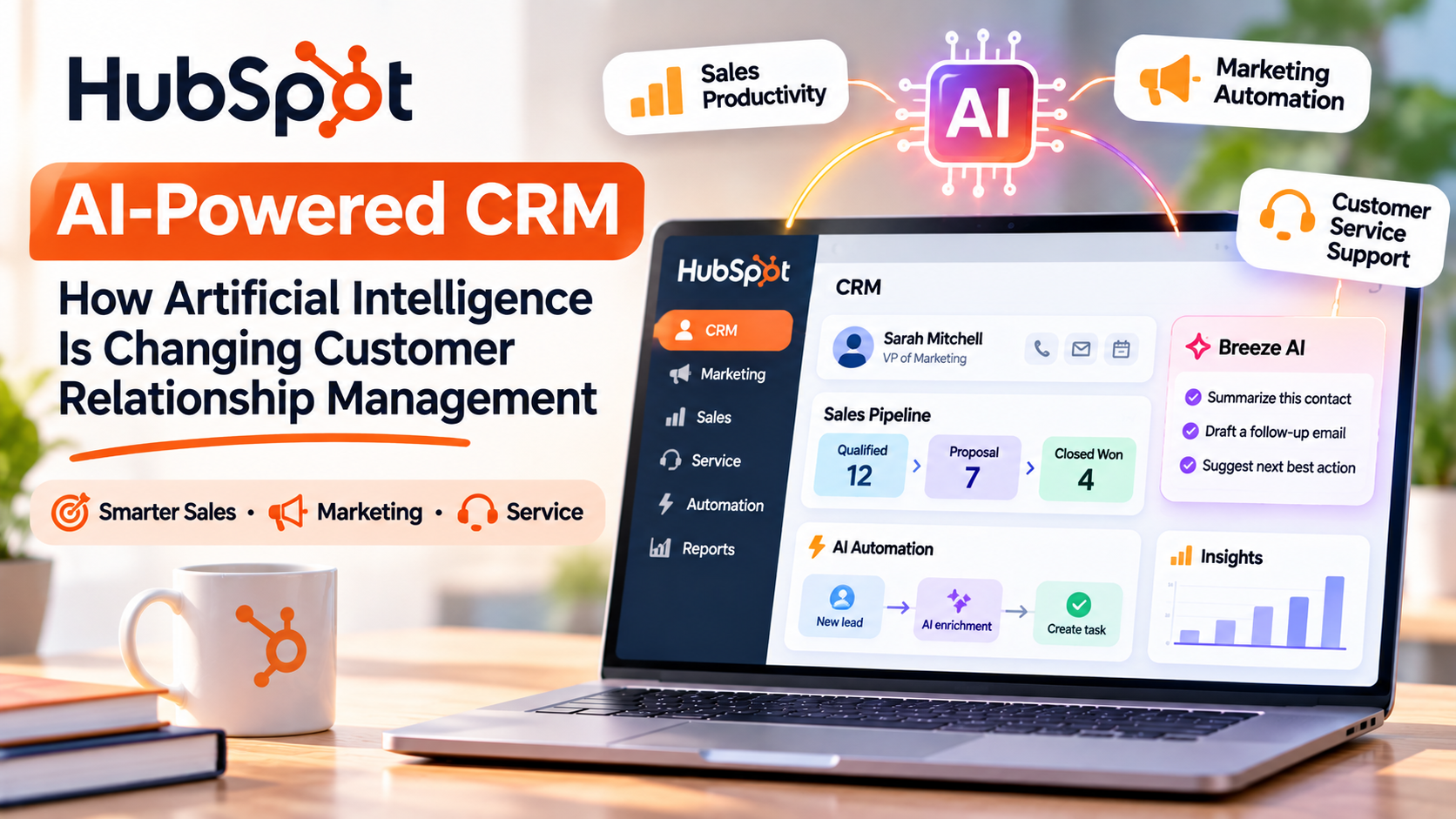
Artificial intelligence is changing the way businesses manage customer relationships.
For years, CRM software has helped companies organize contacts, track sales opportunities, and manage customer interactions.
But traditional CRM systems have one major limitation: they depend heavily on people entering information, analyzing data, and deciding what to do next.
AI-powered CRM is changing that.
Instead of simply storing customer information, modern CRM platforms can help businesses interpret data, identify opportunities, automate repetitive tasks, and make better decisions.
As a CRM and marketing automation consultant and HubSpot Certified Trainer, I believe this represents an important evolution in how businesses should approach customer relationship management.
And one platform worth exploring is HubSpot.
In this article, I'll explain what AI-powered CRM means, how it works, and why I think it deserves serious consideration from growing businesses.
What Is an AI-Powered CRM?
An AI-powered CRM is a customer relationship management platform that uses artificial intelligence to help businesses manage customer data, automate activities, and generate useful insights.
Traditional CRM systems focus primarily on organizing information.
They store contacts, companies, deals, activities, and customer communication histories.
AI-powered CRM builds on those capabilities by helping users understand and act on the information.
For example, AI can assist with:
Summarizing customer interactions.
Drafting personalized sales emails.
Identifying potential sales opportunities.
Automating repetitive administrative tasks.
Analyzing customer behavior.
Supporting customer service conversations.
Generating reports and recommendations.
The goal isn't to replace your sales, marketing, or customer service teams.
It's to help them spend less time on repetitive work and more time building meaningful customer relationships.
How Does HubSpot Use Artificial Intelligence?
HubSpot combines CRM capabilities with AI-powered tools across sales, marketing, and customer service.
Its Breeze AI offering includes an AI assistant and specialized AI agents designed to help businesses complete tasks using relevant customer and business context.
Depending on your subscription and feature availability, these capabilities can support content creation, prospecting, customer support, research, and workflow productivity.
What makes this approach interesting is the connection between AI and your CRM data.
Instead of working with a disconnected chatbot, your team can use AI within the system where customer relationships are already managed.
That connection creates opportunities for more relevant and efficient workflows.
1. AI Can Reduce Manual CRM Administration
One of the biggest complaints I hear about CRM software is that maintaining it takes too much time.
Salespeople don't want to spend their entire day updating records, writing notes, and documenting conversations.
They want to sell.
AI can help reduce some of this administrative work.
For example, supported AI features can summarize information, assist with record preparation, and help users draft follow-up communications.
Imagine finishing a sales meeting.
Instead of starting from scratch, you could use AI-generated meeting information to prepare a summary and identify potential next steps.
Your team would still need to verify the details, but the preparation process could become significantly faster.
My recommendation is to identify repetitive CRM activities first and determine where AI can reduce unnecessary manual effort.
2. AI-Powered Sales Prospecting
Finding and qualifying potential customers is one of the most time-consuming parts of B2B sales.
Sales teams need to research companies, understand business needs, identify decision-makers, and prepare relevant outreach.
HubSpot offers AI capabilities designed to support sales prospecting and outreach activities.
For example, its Breeze Prospecting Agent can assist with prospect research and personalized outreach workflows, subject to the relevant subscription and configuration.
This can be particularly valuable for businesses managing a growing sales pipeline.
However, I always emphasize that AI-generated outreach should be reviewed carefully.
Personalization needs to be based on accurate information.
And automated prospecting must respect applicable privacy, consent, and anti-spam requirements.
The objective should be generating better conversations, not simply sending more messages.
3. Smarter Marketing Automation
Marketing automation is another area where AI-powered CRM can create meaningful value.
Traditional automation follows predefined rules.
For example:
A contact downloads a guide, enters a workflow, and receives a sequence of emails.
That approach remains useful.
But AI introduces additional capabilities that can help marketers create content, interpret information, and improve campaign execution.
With HubSpot, marketing teams can explore AI-assisted content creation, campaign planning, and other productivity features.
For example, you might use AI to draft a lead nurturing email, develop campaign ideas, or summarize marketing performance.
I particularly like the combination of AI and structured automation.
Automation handles repeatable processes, while AI can help with the content and analysis that support those processes.
Together, they can make marketing operations more efficient.
4. AI-Powered Customer Service
Customer service is another important application.
Customers increasingly expect fast, accurate answers.
But small businesses don't always have the resources to provide immediate human support around the clock.
AI-powered customer service tools can help answer common questions and guide customers toward relevant information.
HubSpot offers Breeze Customer Agent capabilities that can support customer conversations using configured knowledge sources.
For example, a business might use an AI agent to help answer questions about services, policies, or common support issues.
More complex conversations can be escalated to a human team member when the workflow supports it.
However, businesses need to ensure their knowledge sources are accurate and up to date.
AI should make customer service more accessible without creating misleading answers or unnecessary frustration.
5. Better CRM Data and Decision-Making
A CRM is only as valuable as the information it contains.
Unfortunately, many businesses struggle with incomplete records, inconsistent data, and outdated contact information.
AI-powered tools can assist with certain data enrichment, research, and analysis activities.
For example, Breeze Intelligence capabilities may help businesses enrich eligible contact and company records, depending on their plan and available credits.
AI can also help users interpret information and identify patterns that might otherwise require manual investigation.
But there's an important limitation.
AI cannot automatically guarantee accurate CRM data.
You still need clear data standards, appropriate permissions, duplicate management, and regular quality checks.
I recommend establishing those fundamentals before relying heavily on AI-generated insights.
6. AI Makes CRM Information More Accessible
Another benefit is the ability to interact with business information using natural language.
Instead of navigating multiple screens or manually preparing every summary, users can ask AI for assistance with supported tasks.
For example, a sales manager might want a summary of an opportunity before a meeting.
A marketer might need help preparing a campaign report.
A customer service representative might need relevant information about an existing customer.
AI assistance can make these activities more convenient.
However, access to information should still follow your organization's permissions and data governance policies.
Businesses should review what information their AI tools can access and how that information is processed.
Is HubSpot AI-Powered CRM Worth It for Small Businesses?
I think the answer depends on your business processes and how your team uses its CRM.
If you're managing a growing number of leads, customer interactions, and sales opportunities, AI-powered capabilities can help reduce administrative work.
They may also improve consistency across your marketing, sales, and service activities.
However, I wouldn't recommend upgrading simply because a platform offers AI.
Start by asking three questions:
Which repetitive activities consume the most time?
Which customer-facing processes could benefit from faster responses?
Which AI capabilities would create measurable improvements?
You should also review pricing carefully.
Some AI features are included in certain subscriptions, while others require higher-tier plans, credits, or additional purchases.
Before making a decision, check the current options directly through HubSpot.
My Recommendations Before Implementing AI-Powered CRM
As a consultant, I recommend approaching AI adoption as a business process improvement initiative rather than simply a software upgrade.
Start with a clean CRM database.
Make sure your team understands how contacts, companies, deals, and activities should be managed.
Then identify one or two specific workflows where AI could make a difference.
For example, you might begin with sales email drafting or meeting summaries.
Once your team is comfortable, explore more advanced applications such as prospecting agents, customer service automation, or AI-assisted reporting.
Measure the results before expanding.
And always maintain human oversight for important decisions and customer-facing communication.
Final Thoughts: Why I Recommend Exploring HubSpot AI-Powered CRM
Artificial intelligence is making CRM software more than a place to store customer information.
It can help businesses understand their data, prepare communications, automate repetitive activities, and improve how teams work together.
That's why I believe AI-powered CRM deserves attention from small and medium-sized businesses.
What makes HubSpot particularly interesting is the combination of CRM, marketing automation, sales tools, customer service, and AI capabilities within a connected platform.
But remember that AI isn't a substitute for good processes.
A successful CRM strategy still requires accurate data, clearly defined workflows, and a team that understands how to manage customer relationships.
The real value of AI-powered CRM isn't replacing people. It's helping people do their jobs more effectively.
If you're looking to improve your sales, marketing, and customer service operations, I recommend exploring what the platform has to offer.
Explore HubSpot's AI-Powered CRM and discover how artificial intelligence could support your business growth.
If you need help setting up HubSpot, get in touch with me.