
HubSpot Campaign Assistant: AI Marketing Asset Creator
Creating a marketing campaign usually sounds easier than it actually is.
You have an idea. Then you realize you need a landing page, an email, advertising copy, headlines, calls to action, and messaging that stays consistent across every channel.
Suddenly, a simple campaign becomes hours of writing and rewriting.
That's exactly the problem HubSpot Campaign Assistant is designed to solve.
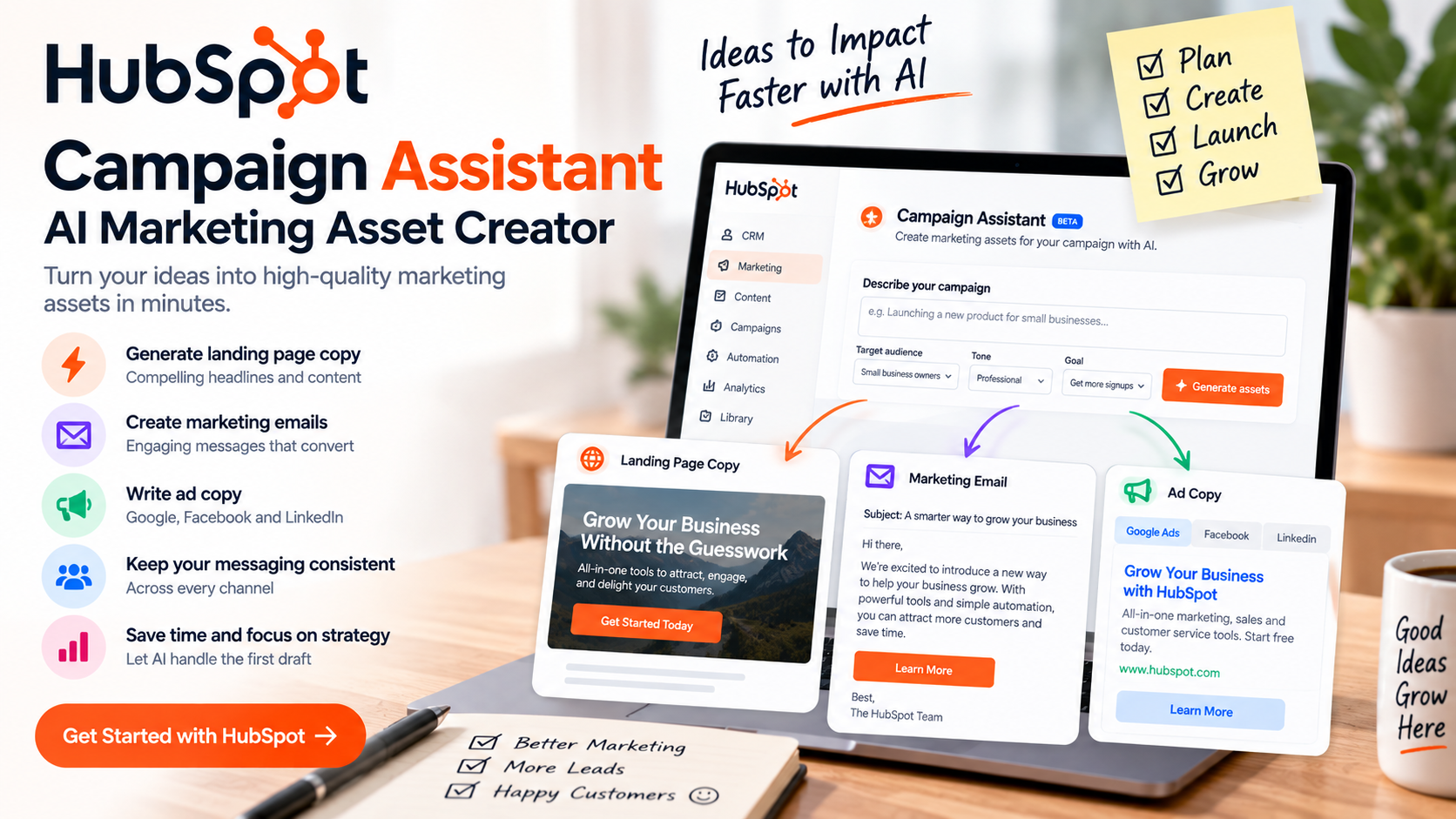
Campaign Assistant is an AI-powered marketing asset creator that turns a description of your campaign into ready-to-edit marketing copy. It can generate landing-page content, marketing emails, and advertising copy for channels including Google, Facebook, and LinkedIn.
For small businesses, marketers, consultants, and agencies, it could dramatically reduce the amount of time spent staring at a blank page.
What Is HubSpot Campaign Assistant?
Campaign Assistant is essentially an AI copywriting assistant specifically designed around marketing campaigns.
Instead of opening a general-purpose AI tool and figuring out exactly what prompt to write, HubSpot guides you through the information it needs.
You provide details such as your campaign objective, target audience, key messages, desired action, and preferred writing style or tone. Campaign Assistant then turns that information into marketing assets appropriate for the channel you've selected.
That structure is important.
You're not simply asking AI:
"Write me an advertisement."
You're giving it the context required to create something connected to an actual marketing campaign.
Create Landing Page Copy with AI
Let's say you're launching a new consulting service.
Normally, you might spend hours deciding what should go on the landing page.
What's the headline?
How do you describe the service?
What should the call to action say?
How should everything be structured?
With Campaign Assistant, you can provide the topic, tone, and desired call to action and have the AI generate a page title, subheadings, and paragraph copy. You can then review the result, modify it, and either publish through HubSpot or use the copy elsewhere.
That's a much easier starting point than a blank screen.
The key word here is starting point.
I would still review the copy, add your own expertise, verify any claims, and make sure the page genuinely reflects your brand.
AI should accelerate your marketing—not remove the human judgment behind it.
Generate Marketing Emails
Campaign Assistant can also generate marketing email copy.
You provide information about the campaign, its purpose, the topics you want covered, and the tone you want to communicate.
The AI creates a draft that you can refine before using it.
If you're working inside HubSpot, the generated copy can be moved into a marketing email, where you can continue editing its design and content before sending or scheduling it.
Imagine you're promoting a webinar.
You could create the landing page explaining the webinar and then generate an email promoting the same campaign.
Instead of starting over, you're building multiple assets around the same underlying message.
That brings us to one of Campaign Assistant's biggest advantages.
Keep Your Campaign Messaging Consistent
Marketing campaigns often become inconsistent when several people or tools are involved.
Your landing page says one thing.
Your email emphasizes something completely different.
Your Facebook ad takes another direction.
Your Google ad barely resembles the original campaign.
Campaign Assistant is designed to create assets around a shared campaign strategy. HubSpot specifically positions the tool around maintaining consistent brand messaging while adapting content for different marketing channels.
That's valuable because consistency doesn't mean copying and pasting the same paragraph everywhere.
A Google search ad shouldn't look like an email.
A landing page needs more information than a Facebook ad.
The message remains consistent, but the format changes.
Create Advertising Copy
Paid advertising is another area where Campaign Assistant can save time.
It can help generate copy for Google Ads, Facebook campaigns, and LinkedIn ads.
Instead of manually brainstorming multiple headline variations, you can use AI to create alternatives and then choose the strongest options.
This can be particularly useful when you're testing different messages.
Maybe one advertisement focuses on saving time.
Another emphasizes reducing costs.
A third highlights a specific product feature.
AI can help you produce those initial variations much faster.
And HubSpot continues to integrate AI directly into its advertising tools. Its current AI assistants can generate content while creating Google, Facebook, and LinkedIn ad campaigns, although some of those integrated advertising capabilities have separate subscription requirements.
A Practical Example
Suppose you own an accounting firm and you're launching a new bookkeeping package for small businesses.
Your campaign objective is:
Generate consultation requests from small-business owners.
Your main message might be:
Stop spending your evenings managing your books.
Your desired action:
Book a free consultation.
Your tone:
Professional, helpful, and straightforward.
You could feed that campaign direction into Campaign Assistant and use it to begin creating your landing-page copy, promotional email, and advertising messaging.
You now have the foundation of a multichannel campaign without individually writing every asset from scratch.
That's where I think the tool becomes genuinely useful.
It doesn't replace your marketing strategy.
It helps execute that strategy faster.
Who Should Use HubSpot Campaign Assistant?
The tool can be useful across several types of businesses.
A small-business owner can use it when they don't have a dedicated copywriter.
A consultant can quickly build assets around a new service or lead magnet.
An agency can use AI-generated drafts as starting points when developing campaigns for multiple clients.
An ecommerce company can create messaging around product launches.
A SaaS company can develop campaigns promoting specific features or use cases.
HubSpot itself highlights marketers, small-business owners, agencies, ecommerce retailers, SaaS companies, freelancers, and content creators among Campaign Assistant's potential users.
Is Campaign Assistant Free?
One of the most interesting aspects is accessibility.
HubSpot currently describes Campaign Assistant as a free AI marketing tool, and its knowledge base lists Campaign Assistant asset creation as available across its products and plans while the feature remains in beta.
However, there's an important distinction.
Campaign Assistant itself being available doesn't mean every related AI or publishing capability throughout the broader platform is free.
For example, some AI-powered advertising functionality requires Marketing Hub Professional or Enterprise, while newer AI functionality elsewhere in the platform can require credits or specific subscriptions.
So check the current requirements for the specific workflow you want to use.
Campaign Assistant vs. General AI Tools
You could reasonably ask:
"Why not just use ChatGPT or another AI writing tool?"
You certainly can.
The difference is workflow.
A general-purpose AI assistant can help with an enormous variety of tasks, but you need to provide appropriate prompts and context.
Campaign Assistant is purpose-built around creating marketing campaign assets.
It asks for information such as your audience, message, style, and CTA, then uses that information to produce the asset you've selected.
There's also the benefit of working within the broader HubSpot ecosystem.
When your marketing tools, CRM, landing pages, emails, advertising, analytics, and AI capabilities increasingly exist within the same environment, there can be less friction between creating something and actually using it.
AI Still Needs a Human Marketer
This is probably the most important point.
I wouldn't generate an entire campaign and immediately publish everything without reviewing it.
AI doesn't understand your customers as well as you do.
It doesn't automatically know whether a claim is accurate.
It may not perfectly capture your brand voice.
And sometimes the first draft simply won't be very good.
Even HubSpot's own guidance for its AI-generated email and landing-page content tells users to review and refine the output before using it.
The better workflow is:
Human creates strategy → AI creates draft → human improves draft → campaign launches → data informs the next campaign.
That's a much more powerful use of AI.
The Bigger Picture: AI Is Becoming Part of HubSpot
Campaign Assistant is also part of a much bigger shift happening across the platform.
As of September 2026, HubSpot is expanding campaign-oriented AI with its Campaign Agent in Marketing Studio. That newer beta can use campaign goals, audiences, briefs, historical performance, industry benchmarks, brand identity, and CRM data to help plan campaigns and create draft assets. Those drafts are still reviewed before publication.
That gives us a pretty clear idea of where marketing software is heading.
AI isn't simply becoming a separate writing application.
It's becoming embedded directly into the workflow where marketers plan, create, distribute, and analyze campaigns.
Final Thoughts
HubSpot Campaign Assistant solves a very practical marketing problem:
Turning an idea into actual campaign assets takes time.
Instead of beginning every landing page, marketing email, and advertisement with a blank screen, you can provide your campaign information and let AI create the first draft.
You remain responsible for the strategy.
You remain responsible for the brand.
And you remain responsible for deciding what ultimately gets published.
But the tedious first-draft stage can become dramatically faster.
For small businesses without a dedicated copywriting team, consultants launching campaigns themselves, or marketers constantly producing new assets, that's a compelling proposition.
Rather than asking AI to replace the marketer, HubSpot Campaign Assistant lets the marketer spend less time staring at a blank page—and more time thinking about the campaign itself.
If you need help setting up HubSpot, get in touch with me.