
lemlist vs. Traditional Cold Email Tools: What's the Difference?
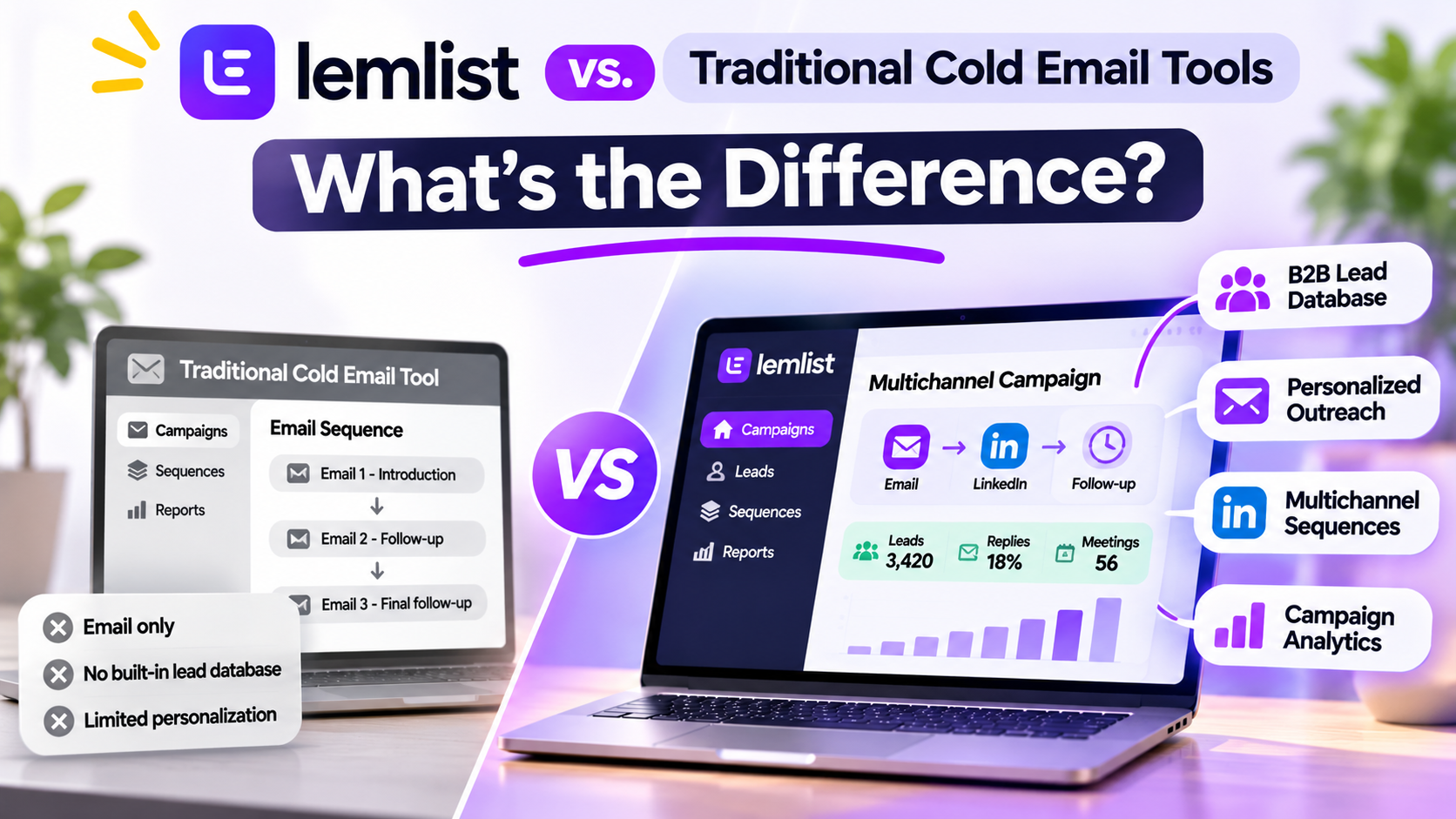
Cold email outreach has changed significantly over the past few years.
Not long ago, running an outbound sales campaign was relatively straightforward. You collected a list of business email addresses, uploaded them into a cold email tool, wrote a sequence of messages, and waited for replies.
Today, successful B2B prospecting requires a more thoughtful approach.
Prospects receive countless sales messages, inbox providers have become more sophisticated, and generic outreach rarely creates a strong first impression.
As a CRM and marketing automation consultant, I believe businesses need to think beyond simply automating email sequences.
They need better targeting, relevant personalization, and a coordinated sales process.
That's why I recommend exploring lemlist.
But how does it compare with traditional cold email tools? And is the additional functionality worth considering?
Let's explore the differences.
Affiliate disclosure: This article contains affiliate links. I may earn a commission if you sign up through them.
What Are Traditional Cold Email Tools?
Traditional cold email tools are platforms designed primarily to automate outbound email campaigns.
Their core functionality typically includes:
Importing prospect lists
Connecting email accounts
Creating email sequences
Scheduling follow-up messages
Personalizing emails with basic variables
Tracking replies and campaign performance
These tools can be useful for businesses that already have qualified prospect lists and simply need a way to manage outbound email activity.
However, many traditional platforms focus primarily on sending and tracking messages.
Prospect research, contact enrichment, LinkedIn outreach, and CRM management may require additional software.
This can create a fragmented sales process.
What Makes lemlist Different?
lemlist is a B2B sales prospecting and engagement platform that combines cold email automation with lead discovery, personalization, and multichannel outreach.
Rather than focusing exclusively on sending emails, it helps businesses manage more stages of the outbound prospecting process.
Its capabilities include:
B2B lead database and prospect discovery
Personalized cold email campaigns
Automated follow-up sequences
LinkedIn outreach steps
Multichannel sales engagement
Email deliverability features
Campaign reporting
CRM integrations
Not every feature is included in every subscription, so it's important to compare plans before purchasing.
The biggest difference is that the platform supports a broader prospecting workflow instead of treating email automation as an isolated activity.
1. Prospect Discovery vs. Imported Contact Lists
One of the biggest limitations of traditional cold email software is that you often need to find prospects somewhere else.
You might use LinkedIn, a B2B database, or manual research to identify companies and decision-makers.
Then you export the information and import it into your email outreach platform.
This process can become time-consuming, particularly for small businesses without dedicated sales development teams.
With lemlist, you can access B2B prospecting capabilities within the same environment used to manage outreach.
For example, imagine you're selling CRM consulting services.
You might want to target marketing directors at growing B2B companies with 20–200 employees.
Instead of researching every prospect manually, you can use available filters to identify relevant contacts.
However, database accuracy and coverage can vary, and some contact data may require additional credits.
I always recommend verifying important information before contacting prospects.
2. Basic Personalization vs. More Relevant Outreach
Most cold email tools support personalization variables.
You can insert a prospect's first name, company name, or job title into an email.
That's helpful, but it's rarely enough.
A message that begins with someone's name and immediately launches into a generic sales pitch isn't truly personalized.
lemlist offers personalization features designed to help sales teams create more tailored outreach campaigns.
Depending on your workflow, you can use prospect information, custom variables, and supported AI capabilities to prepare more relevant messages.
For example, instead of writing:
"Hi Sarah, we help businesses improve sales. Would you like a demo?"
You might write:
"Hi Sarah, I noticed your company is expanding its sales team. Are you reviewing how your CRM handles lead assignment and follow-ups?"
The second message provides a more specific reason to start a conversation.
Of course, that observation should be verified before sending.
My recommendation is to use automation to scale relevance, not generic messaging.
3. Email-Only Campaigns vs. Multichannel Outreach
This is one of the most important differences.
Traditional cold email platforms often focus on one channel: email.
But B2B prospects don't all communicate the same way.
Some prefer email, while others are more active on LinkedIn.
A multichannel approach creates additional opportunities to establish a professional connection.
With lemlist, you can build sequences that combine email with supported LinkedIn activities and other sales touchpoints.
For example:
Day 1: Send a personalized introductory email.
Day 4: Follow up with a relevant insight.
Day 6: Include a LinkedIn touchpoint.
Day 9: Share a useful resource.
Day 13: Send a final, respectful follow-up.
Some LinkedIn activities may require manual action or have limitations based on your subscription and integration setup.
The objective isn't to contact prospects everywhere simultaneously.
It's to coordinate a reasonable number of relevant interactions.
4. Deliverability Is Part of the Process
Email deliverability is essential for any outbound sales campaign.
Even the best-written message won't generate a conversation if it never reaches the intended recipient.
Traditional cold email tools may provide sending controls and basic deliverability features.
lemlist also offers deliverability-related capabilities, including access to email warmup through lemwarm, depending on the product and subscription.
However, no warmup tool can guarantee inbox placement.
Your results depend on several factors:
SPF, DKIM, and DMARC authentication
Sender reputation
Email account configuration
Sending volume
Contact data accuracy
Message relevance
Spam complaints and bounce rates
I recommend treating deliverability as an ongoing responsibility rather than something you solve by activating one feature.
5. Automation vs. Complete Sales Prospecting Workflows
Traditional email tools are useful for automating follow-ups.
But businesses often need more than that.
They need to identify prospects, organize outreach, manage replies, and transfer qualified opportunities into their CRM.
lemlist helps connect several of these activities.
For example, a small sales team could use the platform to find relevant contacts, create a personalized sequence, coordinate follow-ups, and monitor responses.
When someone expresses interest, the team can move the opportunity into its CRM.
As a HubSpot Certified Trainer, I always recommend keeping your CRM as the central system for managing customer relationships and sales opportunities.
Your outreach platform should complement that system, not create another disconnected database.
6. Campaign Analytics and Sales Performance
Most cold email platforms provide campaign reporting.
However, the most important question isn't how many emails you've sent.
It's whether your outreach is generating qualified sales conversations.
lemlist provides reporting capabilities that help users monitor campaign activity and engagement.
I recommend tracking:
Reply rates
Positive replies
Qualified meetings
Opportunities created
Pipeline generated
I wouldn't rely heavily on open rates because email privacy features can make them misleading.
Ultimately, your success should be measured by meaningful business outcomes.
7. Pricing: Is the Additional Functionality Worth It?
Traditional cold email tools can be more affordable when you only need basic email sequences.
A broader prospecting platform may cost more, especially when you add lead database access, contact credits, or multichannel capabilities.
But subscription price isn't the only consideration.
Imagine you're paying separately for a prospect database, email outreach software, and LinkedIn prospecting tools.
A platform that combines several of those functions might simplify your workflow and reduce the number of subscriptions you manage.
On the other hand, if you already have reliable prospect data and only need basic email automation, a simpler tool may be sufficient.
Before deciding, compare the total cost of your sales technology stack.
You can review the latest subscriptions directly on the lemlist website.
Who Should Choose lemlist?
I think the platform is particularly relevant for:
B2B sales teams building outbound prospecting processes
Consultants looking for new business clients
Marketing agencies managing lead generation campaigns
Startups developing their first sales pipeline
Sales development representatives coordinating multiple channels
Traditional cold email software may still be the better choice for businesses with simple outreach requirements, established contact databases, and limited budgets.
Neither option guarantees results.
Both require responsible outreach practices, accurate data, and compliance with applicable privacy and anti-spam laws.
Final Thoughts: Is lemlist Better Than Traditional Cold Email Tools?
The biggest difference comes down to scope.
Traditional cold email tools focus primarily on automating email campaigns.
lemlist takes a broader approach by combining prospect discovery, personalization, multichannel outreach, and sales engagement capabilities.
For businesses trying to build a more organized B2B prospecting process, that combination can be valuable.
However, I wouldn't recommend choosing software based on the number of features alone.
Start by understanding your sales process, identifying the tools you already use, and determining where your biggest bottlenecks exist.
If your main challenge is simply sending follow-up emails, a basic platform may be enough.
But if you're struggling to find qualified prospects, personalize outreach, and coordinate multiple channels, lemlist is worth considering.
Explore lemlist and discover whether its approach to B2B sales prospecting fits your business.
If you need help setting up Lemlist, get in touch with me.