
Why I Recommend Lemlist for B2B Sales Prospecting
Finding new B2B customers isn't easy.
You need to identify the right companies, find the decision-makers, get their contact information, create personalized outreach campaigns, and follow up consistently.
And even when you do everything correctly, there's no guarantee that prospects will respond.
As someone who works with CRM systems, marketing automation, and B2B sales processes, I've seen how much time companies spend trying to build a predictable prospecting strategy.
One of the biggest challenges isn't necessarily finding people to contact. It's building a repeatable process that connects prospect research, outreach, follow-ups, and sales conversations.
That's why I recommend taking a look at Lemlist.
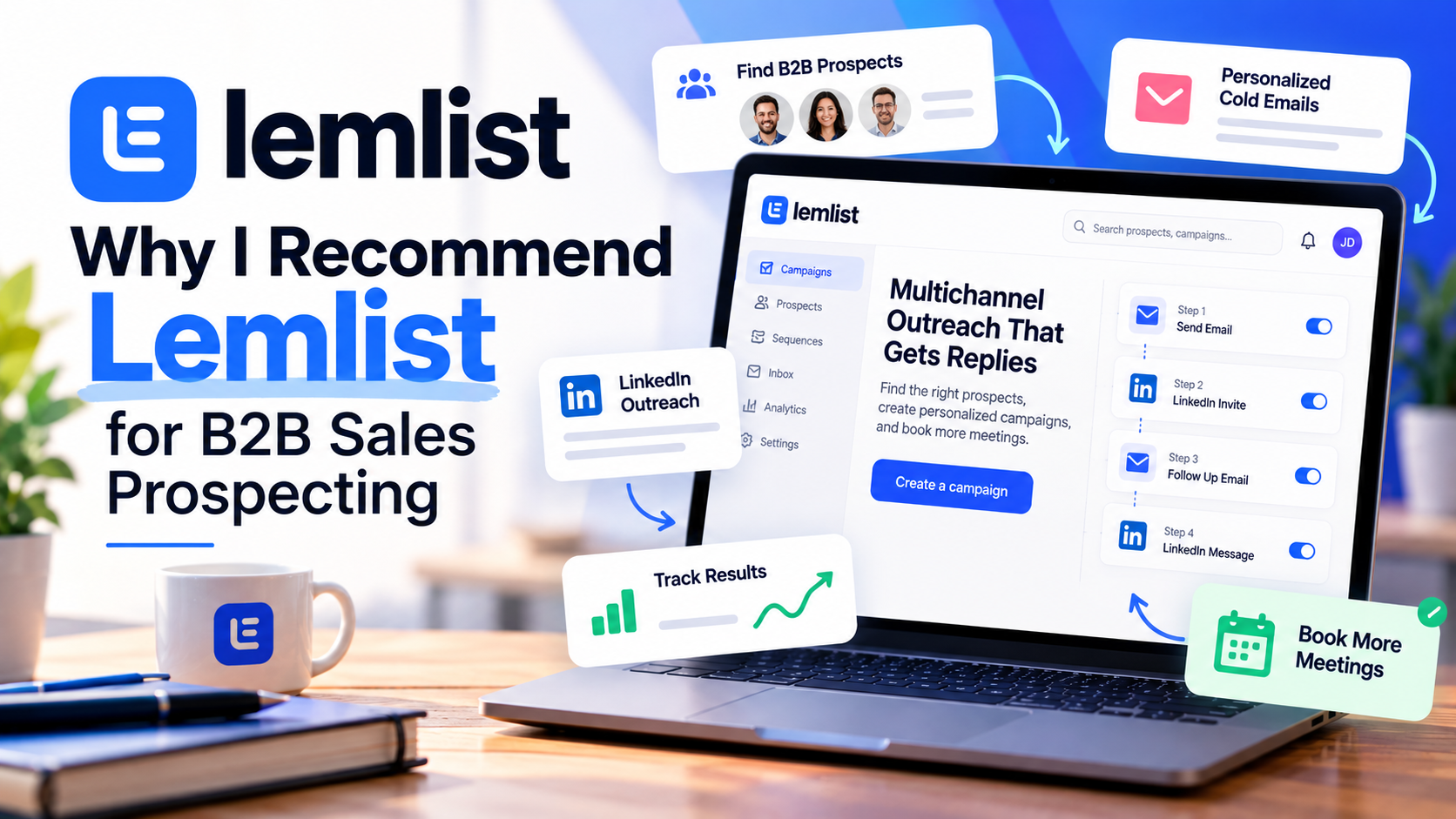
It's a sales engagement platform that combines B2B prospecting capabilities with personalized, multichannel outreach.
And for small and medium-sized businesses looking to grow their sales pipeline, that combination can be particularly valuable.
Here's why I think it deserves a place on your shortlist.
What Is Lemlist?
Lemlist is a B2B sales prospecting and outreach platform designed to help businesses find potential customers and engage them through personalized campaigns.
It brings together several activities that sales teams often manage using separate tools.
These include:
Finding B2B prospects
Building targeted contact lists
Accessing business contact information
Creating personalized cold email campaigns
Coordinating email and LinkedIn outreach
Automating follow-ups
Tracking campaign performance
Instead of treating prospecting and outreach as completely separate processes, the platform helps connect them.
That matters because successful outbound sales requires more than sending emails.
It requires finding the right people, communicating something relevant, and following up at the right time.
1. The B2B Prospect Database Is a Major Advantage
One of the features I find particularly interesting is the built-in B2B prospect database.
Many businesses struggle with prospecting because they don't know where to find qualified leads.
They spend hours searching LinkedIn, visiting company websites, and manually collecting contact information.
A prospect database can make that process significantly more efficient.
With Lemlist, users can search for potential customers using professional and company-related criteria.
For example, imagine you're selling CRM implementation services.
You might want to reach:
Marketing directors at growing companies
Sales managers at B2B organizations
Founders of small and medium-sized businesses
Revenue operations professionals
Companies in specific industries or markets
Rather than building every list manually, you can use prospecting filters to identify contacts who fit your ideal customer profile.
Of course, database coverage and contact accuracy can vary. You should still verify important information before launching campaigns.
But having prospect discovery and outreach capabilities within the same platform can simplify the process considerably.
2. Personalized Cold Email Outreach at Scale
Cold email has a reputation for being impersonal.
And unfortunately, much of that reputation is deserved.
We've all received messages that begin with a generic compliment, immediately launch into a sales pitch, and end with an aggressive request for a meeting.
That approach rarely creates a positive impression.
The better alternative is personalized outreach.
Lemlist provides tools for building email sequences with personalization based on prospect information.
You can tailor messages using details such as a recipient's name, company, role, or other relevant information.
But here's something I always emphasize:
Personalization isn't just inserting someone's first name into an email.
Real personalization means demonstrating that you understand the prospect's business and have a relevant reason for reaching out.
The software helps you scale the execution.
Your sales strategy still needs to provide the substance.
3. Multichannel Outreach Makes Prospecting More Effective
One of the biggest mistakes I see in B2B prospecting is relying on a single communication channel.
Some businesses send one cold email and give up.
Others send multiple emails without considering whether their prospects might be more responsive elsewhere.
In reality, different people prefer different channels.
Some respond to email.
Others are more active on LinkedIn.
And some prefer a direct conversation after an initial introduction.
This is where Lemlist becomes particularly interesting.
Its multichannel capabilities help sales teams coordinate outreach activities across supported channels, including email and LinkedIn.
For example, a prospecting sequence might look like this:
Send a personalized introductory email.
Wait a few days for a response.
Follow up with a relevant insight or resource.
Include a LinkedIn touchpoint.
Send a final, respectful follow-up.
The goal isn't to overwhelm prospects.
It's to create several appropriate opportunities for a conversation.
Some LinkedIn activities may require user action or depend on the platform's current integration capabilities.
4. Automated Follow-Ups Help You Stay Consistent
Following up is one of the most important parts of B2B sales.
It's also one of the easiest activities to forget.
Salespeople get busy.
New leads arrive.
Meetings take priority.
And promising conversations can disappear simply because nobody followed up.
With Lemlist, you can build outreach sequences that schedule follow-up messages based on your campaign settings.
This helps establish a consistent prospecting process.
However, automation should never mean ignoring context.
If someone responds, requests that you stop contacting them, or indicates that they're not interested, your workflow should respect that.
I recommend keeping sequences relatively short, relevant, and focused on delivering value rather than repeatedly pushing for a meeting.
5. It Complements Your CRM
As a HubSpot Certified Trainer, I spend a lot of time helping businesses improve how they manage customer relationships.
And one thing I always emphasize is that your CRM and your prospecting platform serve different purposes.
Your CRM should be the central place where you manage contacts, companies, deals, and customer relationships.
Your prospecting platform helps you identify potential customers and initiate conversations.
These systems work best when they complement each other.
For example, you might use Lemlist to identify prospects and execute outreach campaigns, while your CRM manages the resulting opportunities and sales pipeline.
Depending on your CRM, available integrations, and subscription, you may be able to synchronize relevant contact information and activities.
That creates a more connected sales process and reduces unnecessary manual work.
6. It's Particularly Useful for Small B2B Sales Teams
Large organizations often have dedicated sales development teams, sales operations specialists, and sophisticated technology stacks.
Small businesses usually don't have those resources.
Sometimes the founder is responsible for prospecting.
Sometimes a single salesperson manages everything from lead generation to closing deals.
And sometimes a marketing agency needs to generate leads for multiple clients.
For these teams, simplicity matters.
I like the idea of combining prospect discovery, outreach sequences, and campaign management in one platform rather than purchasing several disconnected applications.
That doesn't mean Lemlist will replace every tool in your sales stack.
But it can reduce the number of separate systems required to run an organized outbound prospecting process.
7. Campaign Reporting Helps You Improve
One of the biggest advantages of using dedicated outreach software is visibility into campaign performance.
Instead of guessing whether your prospecting strategy is working, you can review available campaign metrics.
Depending on your setup, these may include:
Emails sent
Replies received
Positive responses
Campaign performance
Sequence activity
Meetings generated
I recommend paying particular attention to positive replies and qualified meetings.
Open rates alone aren't a reliable measure of success, especially because email privacy features can affect tracking accuracy.
Ultimately, the goal isn't sending more emails.
It's generating meaningful sales conversations.
What Are the Limitations?
No prospecting platform can guarantee results.
Even with a strong database and automated sequences, you still need a clearly defined ideal customer profile, a compelling offer, and relevant messaging.
You also need to consider deliverability.
Poorly configured email accounts, inaccurate contact information, excessive sending volumes, and unwanted messages can damage campaign performance.
And depending on the features you need, pricing, contact-data credits, and subscription limits may affect your total investment.
Before choosing a plan, I recommend reviewing the latest features and pricing directly on the Lemlist website.
Who Should Consider Lemlist?
I think the platform is particularly relevant for:
B2B sales teams looking to generate more qualified conversations
Marketing agencies offering outbound lead generation services
Consultants selling professional services
Startups building their first outbound sales process
Founders who handle their own prospecting
Sales development representatives managing outreach campaigns
It's less relevant for businesses that rely entirely on inbound marketing or don't have a clear reason to contact prospects directly.
And as with any outbound platform, businesses should follow applicable privacy and anti-spam requirements, including consent rules where required.
Final Thoughts: Why I Recommend Lemlist
The biggest reason I recommend considering Lemlist is that it addresses several important parts of B2B prospecting within one platform.
You can find potential customers, build targeted lists, personalize outreach, coordinate multiple channels, and manage follow-ups.
That's a compelling combination for businesses trying to create a more predictable sales pipeline.
But remember that software is only part of the equation.
Successful B2B prospecting still requires a strong understanding of your ideal customers, relevant messaging, responsible outreach practices, and a clear sales process.
If you already have those fundamentals—or you're working toward them—Lemlist is worth exploring.
Explore Lemlist and see how it could help you build a more organized, personalized, and scalable B2B prospecting strategy.
If you need help setting up Lemlist, get in touch with me.