
If AI gives us more time, who are we saving it for?
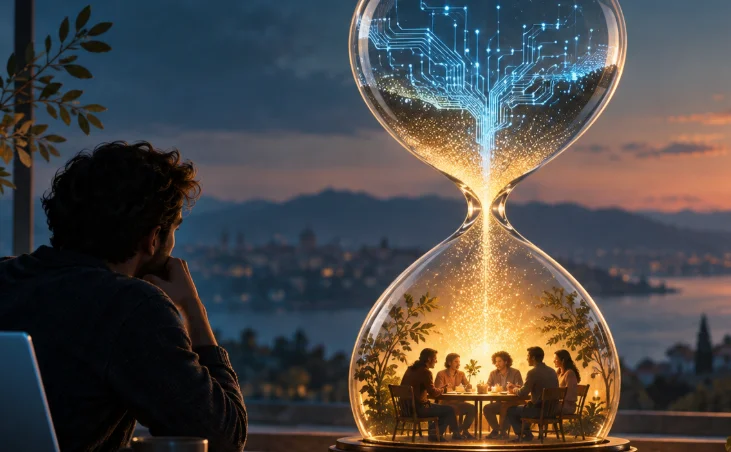
We are living in an era of misconceptions, and I believe the advent of AI is fueling many of them. They affect how we think about education, knowledge, money, and success. They also affect how we treat others, including our willingness to humiliate people in pursuit of whatever we define as success; usually something tied to status, money, or possessions.
I want to start with a personal experience. It was not a pleasant one.
Nobody was listening
The other day, I was looking at used cars on Kavak's website. My impression of the company was positive: a business selling used cars in good condition, at scale, for less than what you would pay for a new car.
But when I requested information about a car, the follow-up call came from what I could clearly recognize as an artificial intelligence representative.
Call it an AI sales representative, an AI SDR, or an AI customer service agent. Whatever the title, I was a potential customer having a conversation with a robot.
The conversation did not feel human because, as far as I could tell, it was not. I was there, interested in buying something, needing someone to listen. Yet I could not seem to reach a human being.
That was the part that stayed with me: the feeling that nobody was listening.
From that experience, Kavak seemed to me like an AI-driven organization. I imagine that being able to delegate customer interactions and sales follow-ups to AI might be considered an accomplishment. From an operational perspective, perhaps it looks like one.
But I do not think that is brilliant. I see it as the beginning of something worse.
AI is magnifying an attitude that was already there: "I don't have time for you. I don't have time for this."
What do we have time for anymore?
If nobody has time for anybody else, what exactly do we want to do with our time?
It seems that we are forgetting something fundamental: whatever we want to do in life, we need others.
God said, "It is not good for man to be alone." I do not understand that statement only as a reference to finding a wife or getting married, which, by God's grace, is also a reality for me. I also understand it as a truth about community.
We work, find fulfillment, and live purposefully in community. We have others whom we serve, and others who serve us. That is how we function.
If the Creator; the one who made us; says that it is not good for us to be alone, then we have a responsibility to listen and apply what He says.
Yet it seems that AI is being used not only to replace human labor, but also to remove the time we spend with one another.
If you no longer had to work, who would you be?
Imagine that you no longer need to work. Somehow, money continues to come in. You can afford whatever you want, and you do not have to work for it. Elon Musk's prediction.
What are you going to do now?
What are you going to do with your time? What is your identity going to be?
If your titles, degrees, and acquired assets are no longer what distinguish you, what is left? If those things no longer define you, who are you?
This is where I believe we fail to recognize that the one who has an identity for us is God, because we are made in His image.
God tells us that He knows the plans he has for us; plans for good, not evil, to give us a future and hope. There is a purpose beyond the titles we hold, the work we perform, and the things we accumulate.
But instead of remembering that purpose, I see AI magnifying some of our worst tendencies: our lack of care for others, our lack of desire to work, our lack of desire to serve, and our love for money.
You no longer have time for anybody. You do not want to talk to anybody.
From the perspective of an entrepreneur, worker, or business owner, that might feel efficient. From the customer's perspective, it feels horrible.
You are the one who needs somebody. You have a question or need help, and you cannot reach a person because you first have to pass through an AI filter.
God said that it is not good for man to be alone, and yet we are building experiences that make people feel alone.
We want people to be filtered by bots. We want them to speak to an AI before they can reach us. And if the AI can handle the entire interaction, even better; we never have to speak to them at all.
But what kind of future are we working toward?
Are we working toward a future in which people do not even want to need others?
We already hear people joke about humanoid robots that someone could fall in love with, or hybrid families made up of both people and robots. To me, that is a horrible future to pursue. It takes this desire to replace human relationships even further.
If God is credible, then what He said is true: it is not good for man to be alone.
Why are we striving to move in that direction?
I think part of the answer is also in Scripture. We are told that people prefer darkness to light because the light exposes their evil deeds. When I consider that, I can understand why humanity might choose a direction that moves us away from what God intended.
And I see this concern not only in the tools we build, but also in the way we think about business.
Consider the enthusiasm around one-person companies.
I think being able to start a company on your own is great. But I used to think of that as a stage: you begin alone, grow the business, and eventually have enough to delegate to others and create jobs. You create opportunities for people to participate. That is part of how we move the economy.
Now it seems that many people want to remain a one-person company indefinitely. With AI, the ambition becomes doing everything without needing anybody else.
Life becomes a “me, me, me” plan. It is about me, myself, and I: my time, my money, my success.
That is what concerns me.
What are we trying to achieve if our idea of success leaves no room for other people? What are we saving our time for if we no longer want to give any of it to someone else?
Let us not forget why we are here.
It is not good for us to be alone. It is not good for us to chase a future in which we think only about ourselves and our time; a future in which we want to be served but no longer want to serve.
That is the direction AI seems to be moving us toward, and I do not think it is a good one.
If we are gaining more time, we should ask ourselves what we intend to do with it; and whether there is still room in our lives for one another.