
Is Lemlist Worth It? My Honest Review
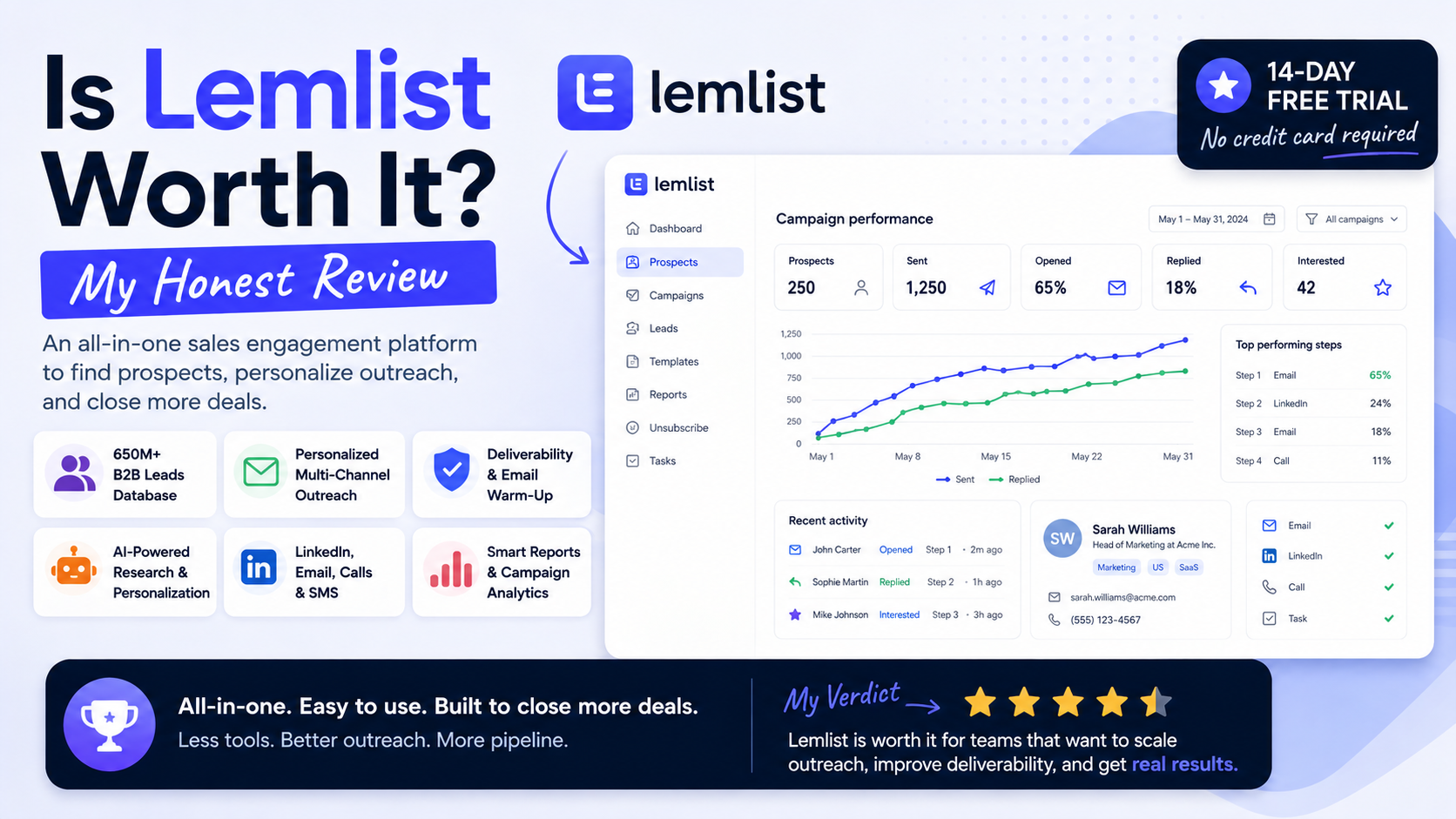
There are a lot of sales tools promising to help businesses find prospects, personalize messages, automate follow-ups, and generate more opportunities.
The problem is that building a complete sales stack can quickly get expensive.
You might have one platform for finding prospects, another for verifying emails, another for email engagement, another for LinkedIn, another for deliverability, and your CRM sitting behind all of them.
That's why Lemlist caught my attention.
It has evolved beyond being simply an email sequencing tool. Today, it combines a large B2B database, contact enrichment, multichannel engagement, AI-powered features, deliverability tools, email warm-up, CRM integrations, and more.
So the obvious question is:
Is Lemlist actually worth paying for?
For the right business, I think the answer is yes.
But it isn't for everyone.
Here's what you should know before signing up.
What Is Lemlist?
Lemlist is an all-in-one sales engagement and prospecting platform designed primarily for B2B teams.
Instead of focusing on only one part of the sales process, the platform brings several important capabilities together.
According to its current product offering, you can use it to find prospects from a database of more than 650 million leads, find and verify contact information, create personalized campaigns, manage email deliverability, and connect with prospects across multiple channels.
That makes it particularly interesting for businesses that want to reduce the number of separate applications required to run their sales process.
The B2B Database Is a Huge Advantage
One of my favorite things about Lemlist is that prospecting is built directly into the platform.
This is important because many people still think of it primarily as an email tool.
It isn't.
The current platform provides access to a database of more than 650 million leads, alongside account-based prospecting, centralized contact management, lead scoring, email finding and verification, phone-number finding, and LinkedIn enrichment.
That means you can potentially move from:
Who should I contact?
to:
I found the person.
to:
I have their business contact information.
to:
They're ready for my sales workflow.
without constantly jumping between platforms.
For consultants, agencies, startups, and lean sales teams, that's a major advantage.
Personalization Is Where It Gets Interesting
Automation is useful.
Bad automation isn't.
We've all received messages that supposedly contain "personalization" but clearly came from a generic template.
Lemlist puts considerable emphasis on personalization, including custom text and images, conditional campaign steps, and AI-powered functionality.
The goal isn't simply to send more messages.
It's to make scalable communication feel more relevant to the person receiving it.
That distinction matters.
I'd rather send 50 highly relevant messages than 5,000 messages nobody wants to read.
Multichannel Is One of Its Biggest Strengths
Modern B2B selling doesn't happen through a single communication channel.
Some prospects respond to email.
Others are active on LinkedIn.
Sometimes a phone conversation makes more sense.
And increasingly, depending on the market, WhatsApp and SMS can become part of the conversation.
The Multichannel plan for Lemlist currently supports email alongside LinkedIn automation, SMS automation and calling, while WhatsApp automation is available as an add-on.
This allows you to create a much more coordinated sales process rather than treating every channel as a separate campaign.
That's a major reason I'd choose it over a basic email sequencing platform.
Deliverability Isn't an Afterthought
This might be one of the most underrated parts of Lemlist.
Sending an email doesn't mean someone receives it.
Sender reputation, DNS configuration, bounce rates, sending patterns, spam complaints, and inbox placement all matter.
The platform currently includes a Deliverability Hub and warm-up functionality, alongside tools for DNS setup testing, custom tracking domains, inbox rotation, deliverability testing, sending-limit management, and alerts.
I like that deliverability isn't treated as something you need to figure out completely separately.
You still need responsible sending practices and good data, of course. No tool can compensate for poor email practices.
But having deliverability functionality built into the same ecosystem is valuable.
The AI Features Are Becoming More Important
Like virtually every major sales platform, Lemlist has invested heavily in AI.
What's interesting is how AI is being integrated into the actual sales workflow.
The platform currently advertises AI capabilities for sourcing and researching leads, enriching data, identifying intent signals, and creating personalized messaging.
That's where AI makes sense to me.
Not:
"Let AI spam everyone."
But:
"Let AI eliminate some of the repetitive research and preparation that consumes a salesperson's day."
If your team can spend less time manually researching spreadsheets and more time having useful conversations, that's a meaningful productivity improvement.
What About the Price?
This is where the "Is it worth it?" question becomes more nuanced.
As of August 2026, the entry Email plan is listed at $69 per month on monthly billing, or an equivalent $55 per month when billed yearly, for the 50,000-email-per-month tier. That plan currently includes unlimited users and email senders.
The Multichannel plan is listed at $109 per user per month, or $87 per user per month when billed yearly. Enterprise pricing is customized.
So no, it's not the cheapest tool you could possibly buy.
But price needs context.
If you're comparing it against one simple email sender, it may look expensive.
If you're comparing it against the combined cost of a B2B database, enrichment platform, email sequencing tool, deliverability platform, LinkedIn workflow tool, dialer, and AI sales tools, the calculation starts looking very different.
That's where I think the value proposition becomes much stronger.
Watch the Credit System
There is one cost consideration I'd pay attention to.
Lemlist uses credits for certain usage-based capabilities, including enrichment, verification, AI functionality, and calling.
Credits are currently valued at $0.01 each and are charged when an eligible action successfully returns a result. The Multichannel plan includes monthly credits, while the Email plan does not currently include free credits.
That doesn't make the pricing bad.
It simply means you should understand your expected usage before deciding what the platform will really cost your business.
Who Is Lemlist Best For?
I think the platform makes the most sense for B2B organizations that actively need to find and engage potential customers.
That includes agencies, consultants, SaaS companies, startups, recruiters, SDR teams, business-development teams, and other B2B organizations with a repeatable prospecting process.
It's especially compelling for smaller teams trying to consolidate their sales technology stack.
Instead of buying five specialized platforms and then trying to connect them all together, you can bring a surprising amount of the process into one ecosystem.
Who Probably Doesn't Need It?
Despite all the features, Lemlist isn't something I'd recommend automatically.
If you operate a purely B2C business, generate all your customers through inbound traffic, don't have a defined sales process, or simply send an occasional newsletter, you're probably not going to use enough of the platform to justify it.
Likewise, if all you need is basic email marketing, there are simpler platforms.
This is fundamentally a B2B sales prospecting and engagement platform.
You get the most value when you're actually going to use those capabilities.
What I Like Most
If I had to summarize the strongest parts of Lemlist, they'd be:
The massive B2B prospect database
Contact enrichment and verification
Multichannel engagement
Strong personalization
Built-in deliverability and warm-up functionality
AI-assisted prospecting and research
CRM integrations
The ability to consolidate multiple sales tools
It's the combination that makes the platform compelling.
None of these concepts individually is revolutionary.
Putting them together into one workflow is where the value appears.
What I Don't Like
No review would be useful without discussing the drawbacks.
First, the number of features can be overwhelming if you're completely new to sales automation.
Second, the Multichannel plan becomes a more meaningful expense as you add users.
Third, the credit-based model means your subscription price isn't necessarily your total cost if you're heavily using enrichment and other credit-consuming features.
And finally, having powerful automation doesn't mean you should automate everything.
Your sales strategy, targeting, messaging, data quality, and processes still matter.
Software amplifies a good system.
It doesn't create one for you.
Is Lemlist Worth It?
For the right B2B organization, yes—I think it is.
The biggest reason isn't any single feature.
It's consolidation.
You can find prospects, enrich their information, personalize communication, build multichannel sequences, manage deliverability, leverage AI, and connect the process with your CRM without assembling an unnecessarily complicated sales stack.
That's particularly attractive for startups, agencies, consultants, and growing sales teams.
For businesses that only need basic email marketing, it's probably overkill.
But if prospecting and business development are meaningful parts of how your organization grows, Lemlist deserves serious consideration.
Final Verdict
I'd rate Lemlist highly for B2B prospecting, personalization, multichannel sales engagement, and sales-stack consolidation.
The built-in B2B database makes it much more than an email automation platform, while its deliverability tools address one of the biggest challenges associated with email-based prospecting.
Is it perfect?
No software is.
But if you're currently paying for several different applications to find prospects, enrich data, manage engagement, and protect deliverability, consolidating more of that workflow inside Lemlist could make a lot of sense.
And because there's currently a 14-day free trial, you can test the Multichannel functionality before deciding whether the platform deserves a permanent place in your sales stack.
My verdict: For businesses serious about B2B prospecting and sales engagement, Lemlist is worth trying.
If you need help setting up Lemlist, get in touch with me.