
The Last Human Job Left
The other day I had a meeting with my bro George B. Thomas, a HubSpot and Inbound marketing legend, absolute industry titan, who has added more value to the marketing sphere than all MarTech combined, all while remaining a happy, helpful, and humble human.
My dude George has helped CEOs, CMOs, VPs and Heads of Sales, Marketing, Customer Success, even heads of IT, wrangle the monster that is implementing and making HubSpot work as an organizational/corporate strategy that makes these companies thrive.
In our meeting, he showed me what he had been able to implement with GrokBot during only 4 business days of having signed up for it (or hours, maybe), and the results were astonishing. My bro had a whole team going on. I’m not talking about just a marketing team performing menial copywriting, blog publishing, Reddit scraping, or social sharing tasks. I’m talking about an actual growth performance team of rockstar AI agents communicating with each other, coming up with and sticking to a plan, moving the business forward with minimal human intervention (except that which is needed for approvals before tweaking stuff in sensitive areas of the CRM portal). Talk about a team of agents on a mission.
When I hopped off that call, and the day ended, I went to bed (actually, a hammock, I sleep in a hammock since 2023) that night, and I had one of the longest nights I have had in a while. I probably slept about 3.5 hours or so, and none of them were continuous.
Now, this is not a post about my occasionally horrible sleeping habits. But rather, my point has to do with something I had never taken seriously until my meeting with my dude George.
And that is, something that Elon Musk said in a recent interview (and I paraphrase here): “There is going to be a time (sooner, rather than later), where there will virtually be nothing that AI cannot do better than humans”.
Imagine me right there, it's freaking 3:15am in the morning, and the only thing I could think about is that I had memorized that quote from Elon Musk, yet, it was not until my meeting with George that I had even remotely started meditating on it. And suddenly, deep reflection took over.
Now, I consider myself quite skillful in many areas, particularly in digital marketing, and more specifically in MarTech, CRM, and AI “real-world business use cases” implementation.
But I could not for the life of me stop thinking about this:
“Inevitably, AI, at some point, will do my job, will run my company, will serve my clients, better than I ever could”.
Boom!
Talk about taking a bath of humility. I admitted it, and I am convinced.
Yet, today, I wanna tell you why humans will always be needed, and maybe even preferred for certain aspects of a business, even in purely digital settings and industries.
And no, it's not only the ambiguous definition of the “human touch”.
It's not that somebody has to approve the transactions of real money.
The word you need to remember is:
ACCOUNTABILITY.
Period.
Nothing else, nothing more.
Accountability is more important today than ever.
But why?
Because no matter how intelligent, fast, or autonomous an AI agent becomes, somebody still has to answer for what it does.
When the strategy works, the AI can get the credit.
When it fails, though?
When the wrong email goes out to 40,000 people?
When an agent exposes private customer information, makes an unlawful hiring recommendation, publishes a deceptive claim, violates somebody’s copyright, or changes a CRM record that the company was legally required to preserve?
When the business gets hit with a lawsuit, a regulatory investigation, a data-subject request, an audit, or a gigantic compliance fine?
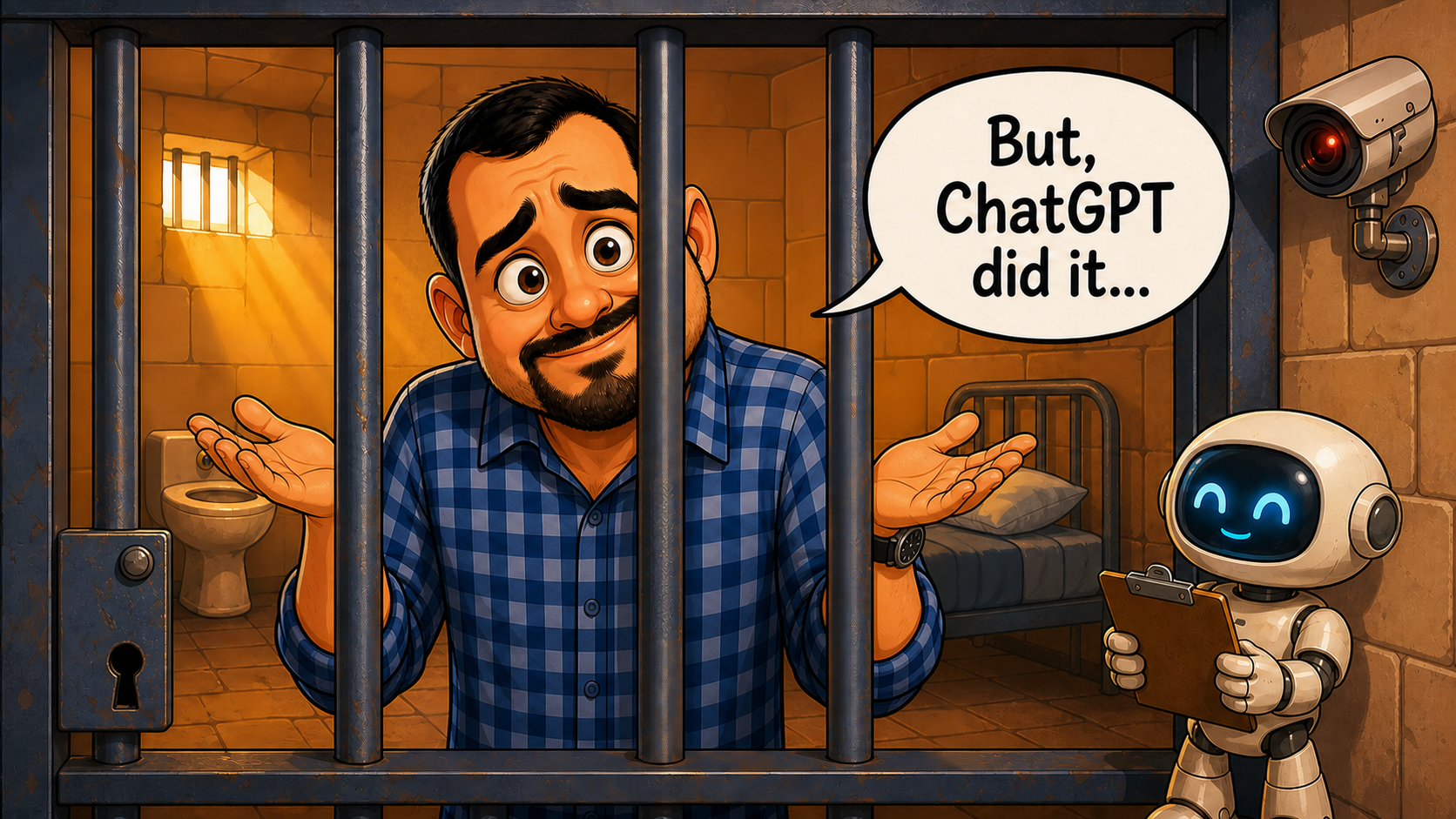
You cannot put ChatGPT through a trial, nor behind bars.
You cannot suspend an AI agent’s professional license.
You cannot garnish a chatbot’s wages, remove it from the board, or make it appear before Congress and swear under oath that it will tell the truth.
And good luck telling a regulator:
“Well, Your Honor, the AI did it.”
That might explain how something happened.
It does not determine who is accountable for allowing it to happen.
Sure, you can deactivate the agent. Delete the model. Revoke its access. Roll back the workflow. Maybe even blame the vendor.
But none of that is accountability.
That is just turning off the tool.
Accountability means accepting the consequences of how the tool was selected, configured, supervised, and used.
Because compliance does not disappear when a process becomes autonomous.
If anything, the risk multiplies.
A human employee might make one bad decision before somebody notices. An AI agent can make that same bad decision 100,000 times before lunch; and document each one with flawless confidence. As Myles Munroe put it bluntly some time ago “You don’t live with the decisions, you live with the consequences”....
It can send unauthorized messages at scale.
It can process personal data for purposes nobody properly approved.
It can produce discriminatory outcomes without ever using an explicitly discriminatory instruction.
It can make claims the company cannot substantiate.
It can give different customers materially different treatment.
It can move information across systems, vendors, accounts, and borders faster than the legal or compliance team can even identify where it went.
And it can do all of that while everyone in the company assumes somebody else is watching.
That last part is where the real danger lives.
Not necessarily in evil AI.
Not even in incompetent AI.
But in highly capable AI operating inside an accountability vacuum.
You can ask an AI what happened, of course.
And it may give you a brilliant answer. It can reconstruct the chain of events, surface the relevant logs, identify the failure, cite the policy that was violated, and recommend seventeen controls to prevent it from happening again.
But it cannot stand up and say:
“This was my responsibility. I made the call. I own the consequences. And I will make it right.”
That is the difference.
AI can perform the work.
AI can evaluate the work.
AI can supervise other AI doing the work.
It can document every step, maintain an audit trail, calculate risk, flag uncertainty, and escalate exceptions faster than any human team ever could.
But accountability is not simply the ability to explain what happened.
Accountability is the obligation to answer for what happened.
It is the acceptance of consequences.
And consequences; legal, financial, ethical, relational, regulatory, and reputational, still land on human beings and the organizations they lead.
They land on the founder whose name is attached to the company.
They land on the executive who approved the strategy.
They land on the manager who deployed the system.
They land on the compliance officer who signed off on the controls.
They land on the employee who trusted the recommendation.
And, sadly, they often land hardest on the customer who was affected by the decision.
This is why the future of business is not simply “AI replacing humans.”
It is AI doing an increasingly absurd percentage of the execution while humans become responsible for defining the boundaries within which that execution happens.
Somebody has to decide what the AI is allowed to optimize for.
Somebody has to decide what data it can access.
Somebody has to establish when human approval is mandatory.
Somebody has to test for bias, monitor for drift, maintain the audit trail, investigate incidents, and prove that the business exercised appropriate oversight.
And somebody has to decide which shortcuts are unacceptable, even when those shortcuts are profitable, efficient, and technically legal.
Somebody has to say:
“Yes, the data supports this decision, but we are not doing it.”
Because businesses are not mathematical equations.
They are promises between people.
A promise that the product will work.
A promise that the customer will be treated fairly.
A promise that private information will be protected.
A promise that the company will obey the rules governing its industry.
A promise that employees will not be sacrificed every time a spreadsheet discovers a cheaper alternative.
And a promise that when something goes wrong, there will be somebody on the other side who actually cares.
AI can help us keep those promises.
It may eventually become better than us at predicting when we are about to break them.
But it cannot be the moral, legal, or fiduciary owner of the promise itself.
And this is where I believe many companies are going to get the whole AI revolution terribly wrong.
They will assume that because AI can execute a decision, it should also be allowed to own the decision.
They will confuse automation with authority.
They will confuse intelligence with judgment.
They will confuse an audit log with responsible oversight.
And, perhaps most dangerously, they will use AI as a fog machine for responsibility:
“The model recommended it.”
“The agent approved it.”
“The system made the decision.”
No, it didn’t.
A human being decided to deploy that system, gave it access, established; or failed to establish, its boundaries, and chose how much oversight it required.
That human may have delegated the task.
But accountability cannot be delegated into nonexistence.
So, will we continue needing humans because AI cannot write the email, build the workflow, analyze the pipeline, serve the customer, develop the strategy, or run the company?
No.
AI will do all of those things, and it may do them better than us.
We will continue needing humans because every business needs someone who can meaningfully say:
“The buck stops with me.”
And, ironically, the more powerful and autonomous AI becomes, the more important that person will be.
Because in a reality where almost every task can be automated, accountability may become the most valuable human job left.